

CEMAC : Economic media, the overlooked strategic pillar of regional financial markets

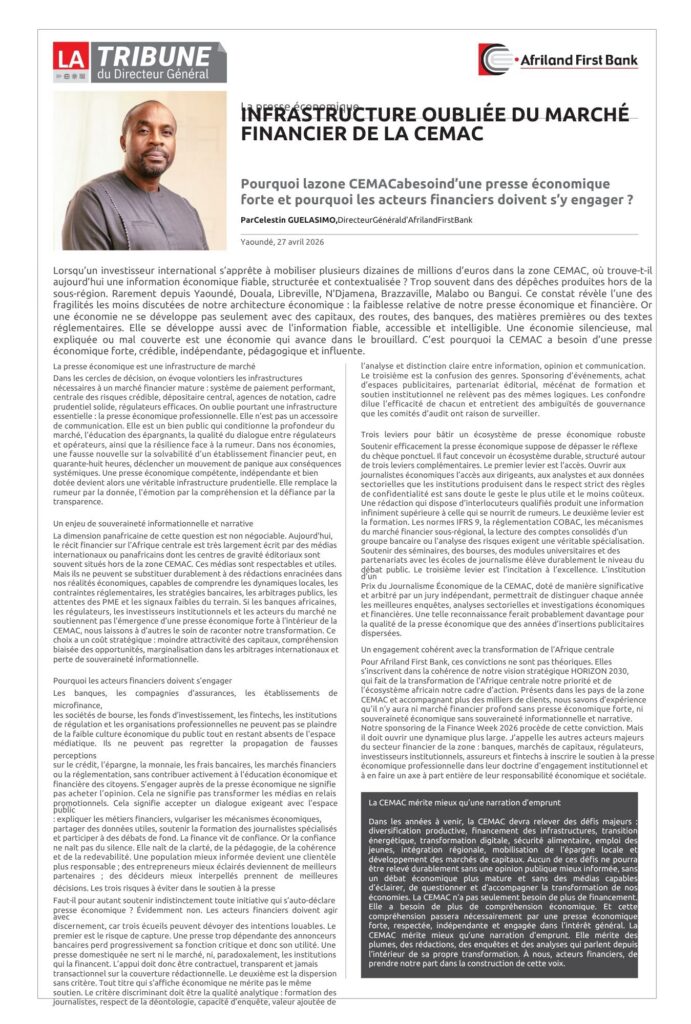
(LVDE) – In an op-ed published on April 27, 2026 in Yaoundé, Célestin Guela Simo, Managing Director of Afriland First Bank, calls on financial stakeholders in the CEMAC to actively support the development of a strong economic press. His analysis highlights the central role of economic information in structuring markets and driving the sub-region’s transformation.

Célestin Guela Simo, Managing Director of Afriland First Bank.
As the CEMAC region seeks to enhance its economic attractiveness, a structural weakness remains largely underestimated: the lack of a credible and well-developed economic press capable of shedding light on market dynamics. In his analysis released in Yaoundé, Célestin Guela Simo emphasizes that economic information should be regarded as a core infrastructure, on par with financial systems and regulatory frameworks. Without it, economies operate in an environment shaped by opacity and uncertainty.
Across the six CEMAC member states, where financing needs amount to billions of dollars to support infrastructure and industrialization, the quality of information becomes a decisive factor. Yet, a significant share of economic reporting on the sub-region is still produced by international media outlets, leaving a gap in locally grounded analysis. This informational dependency limits the understanding of investment opportunities and weakens the narrative sovereignty of states.
For the author, economic journalism goes far beyond a communication tool. It plays a structuring role in shaping expectations among economic actors, disseminating financial literacy, and preventing crises. In a context where rumors about the solvency of a financial institution can trigger panic within days, access to reliable and verified information becomes a key element of systemic stability. Specialized media thus act as a buffer against informational shocks.
Beyond stability concerns, the issue is also educational. In a region where banking penetration remains low and access to financial markets is still limited for small and medium-sized enterprises, the popularization of economic mechanisms is essential. A robust economic press can help improve understanding of financial products, strengthen investor confidence, and support businesses in accessing funding.
However, the involvement of financial actors must follow clear principles. Célestin Guela Simo warns against the risks of editorial dependence, stressing that poorly structured support could undermine media independence. He advocates for transparent partnerships based on analytical quality and professional ethics, in order to avoid any confusion between information and promotion.
To build a sustainable ecosystem, three key levers are identified. The first is access to information, enabling economic journalists to engage with decision-makers and obtain sectoral data. The second is training, which is essential to address complex topics such as banking regulations and international financial standards. The third lever is the promotion of excellence, notably through awards recognizing high-quality economic journalism.
Through this op-ed, the head of Afriland First Bank calls for collective mobilization among banks, regulators, and investors. The challenge extends beyond the media sector to the overall competitiveness of the sub-region. High-quality economic information can strengthen trust, attract capital, and improve both public and private decision-making.
In a context of accelerating economic transformation, specialized media emerge as a crucial component of the regional financial architecture. For CEMAC, the challenge is no longer only to finance growth, but also to better tell it, explain it, and make it visible at both local and international levels.

 La voix des entreprises
 Esther Grâce