

DOUALA PORT AUTHORITY : Behind the Scenes of a Managerial and Structural Transformation Led by Cyrus Ngo’o

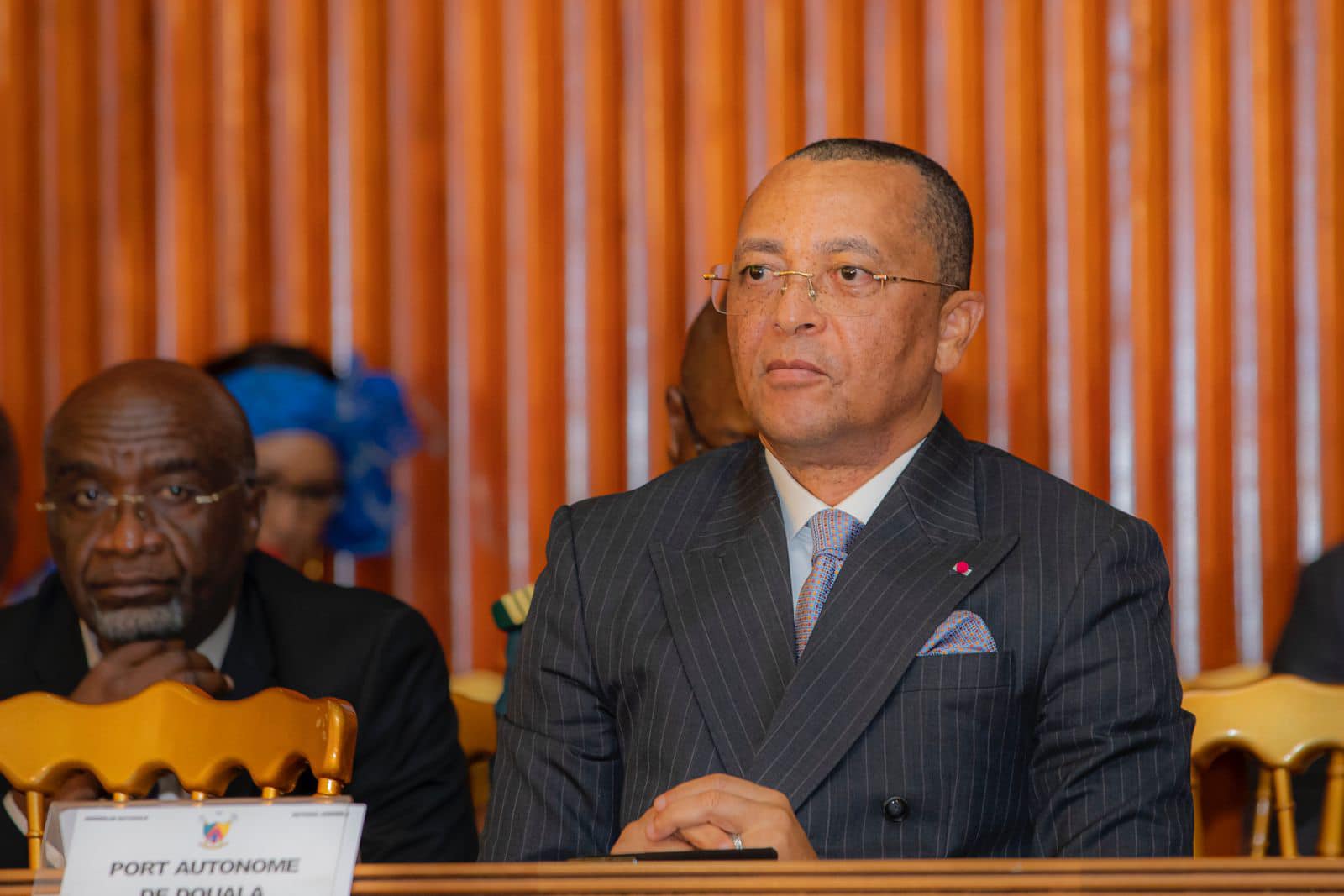
Cyrus Ngo’o, Director General of the Douala Port Authority.
(LVDE) – What was once a declining port is now the beating heart of Cameroon’s economy, with a constant flow of ships, containers, and major development projects. The Douala-Bonabéri Port stands today as a remarkable example of transformation achieved in less than a decade.
Just under ten years ago, the Douala-Bonabéri Port Authority was at a crossroads. Plagued by chronic dysfunction, it was struggling to maintain its position as Central Africa’s leading port. “The port was slowly dying,” recalls a former senior manager who preferred to remain anonymous. Ships would sometimes wait for weeks to dock, costs were skyrocketing, and Cameroon’s reputation was taking a hit in international markets.
The port, which handles 70% of the country’s external trade, was generating 1,365 billion CFA francs annually and supporting nearly 167,000 jobs. Its decline threatened not only its own future but that of the entire national economy.
It was in this difficult context that, in 2016, President Paul Biya appointed Cyrus Ngo’o as Director General of the Douala Port Authority. A former customs officer, Ngo’o, then 55 years old, was undaunted by the magnitude of the task. “We are going to take our destiny back into our own hands,” he declared at the outset, showing unwavering determination.
His first major decision was to break with the outdated and ineffective concession model. In July 2017, a presidential decree reorganized the Douala Port Authority into a group structure with autonomous units, allowing the state to regain greater control over this critical development tool. “It was a return to sovereignty,” said a port economics expert.
The early years under Ngo’o’s leadership resembled a massive clean-up operation. The first challenge was to clear the Wouri River, where 25 shipwrecks were obstructing the channel. “It had become a true naval graveyard,” said a port pilot. Between 2018 and 2019, a salvage operation was launched, costing billions but making port access safer. At the same time, the purchase of a suction dredger allowed the port to manage its own channel maintenance.
Another powerful symbol of the port’s rebirth was the reconstruction of the petroleum jetty, abandoned for 15 years. “Its restoration marked a turning point,” explained a Douala Port Authority official.
In 2020, a decisive shift occurred when the state took back control of the container terminal, triggering a wave of investment. Between 2020 and 2024, the Douala Port Authority invested more than 44 billion CFA francs—more than the 43.5 billion invested in 15 years by the former concessionaire. These funds were used to purchase cutting-edge equipment: eight yard gantries, two 125-ton quay cranes, and 20 Terberg port tractors. “The transformation has been spectacular,” said one dockworker. “We now use machines we never imagined having access to.”
The renewal of the tugboat fleet also symbolized this rise in standards. In October 2023, a contract worth 11.66 billion CFA francs was signed with Damen Shipyards for two ASD 2811 tugboats—the first acquisition of this kind since the end of the concession with Boluda.
Digitalization of port processes was another of Ngo’o’s priorities. A partnership with CPA/Autodesk helped train terminal engineers in digital modeling technologies. “We’ve gone from the Stone Age to the digital era,” said an enthusiastic engineer at the port. “We can now anticipate problems even before construction begins.”
In March 2023, the new multipurpose quay at the timber terminal—worth over 10 billion CFA francs—was inaugurated, replacing a 50-year-old structure. “It shows our ability to deliver major projects on time,” a port executive pointed out. A year earlier, in March 2022, a convention was signed for a mixed bulk terminal requiring a massive investment of 280 billion CFA francs. Spanning 42 hectares, this project will significantly boost the port’s reception capacity.
The ongoing expansion of the container terminal aims to increase traffic from 380,000 TEUs to over a million by 2030. In July 2025, the foundation stone for this expansion—valued at 47.2 billion CFA francs—will be laid as part of a public-private partnership. A 25-hectare logistics platform for empty containers, with a budget of 50.4 billion CFA francs, is also under development.
In addition, in October 2024, a partnership was signed with ARISE IIP to develop the Dibamba industrial and port area. This 517-hectare project includes a multimodal logistics hub and an integrated industrial park. “With Dibamba, we are creating a full-fledged industrial ecosystem,” explained a PAD advisor.
Today, the performance of the Douala Port Authority is impressive. The port now generates 85% of the country’s customs revenue, about 700 billion CFA francs. “All indicators are green,” a senior official noted. Waiting times have dropped, and customer satisfaction is rising. The rehabilitation of 16,000 square meters of yards is further proof of the transformation.
Yet, Cyrus Ngo’o isn’t resting on his laurels. The outlook for 2030 is ambitious, with many projects set to gradually come online. “Our goal is to make Douala the leading port hub in Central Africa,” he insists. Given the progress made since 2016, few would bet against him.
In less than a decade, Cyrus Ngo’o has turned a struggling port into a modern logistics platform. His success stems from a combination of restored sovereignty, innovation, and ambition. Today, when ships dock in Douala, they find a port that meets international standards.
The man behind this achievement knows he’s making history. “In twenty years, our children will thank us for having the courage to take our destiny into our own hands,” he confides. That sentence rings like a legacy from the man who restored pride and hope to Cameroon’s main port.
Esther Grace

 La voix des entreprises
 Amélie Yandal
 Esther Grâce
 Tressy CHOUENTE