

CUSTOMS REVENUE : Kribi Autonomous Port collects nearly CFAF 350 billion in 2025

(LVDE) – With CFAF 335 billion in customs revenue mobilized in 2025, the Kribi Autonomous Port (PAK) confirms its rise within Cameroon’s economy. This performance reflects the steady ramp-up of the port platform since its commissioning and strengthens its role in diversifying government revenue sources.
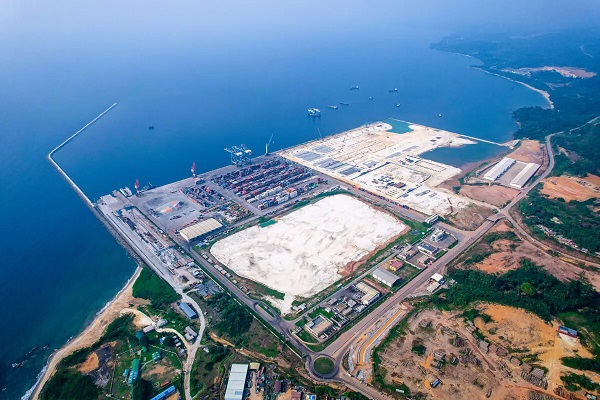
The Kribi Autonomous Port is now emerging as a key driver of public revenue mobilization in Cameroon. At the end of the 2025 financial year, customs revenue collected in the South II sector reached CFAF 335 billion, according to official data. This represents about 4.3% of the revised state budget and positions the platform as the country’s second-largest customs hub, behind the Port of Douala.
Throughout the year, monthly collections remained relatively stable at high levels, ranging from CFAF 32.2 billion in January to CFAF 35.4 billion in December. This consistency reflects both the consolidation of trade flows and the increasing efficiency of revenue collection mechanisms. Since the launch of its commercial operations in March 2018, the port has generated an estimated cumulative CFAF 1 trillion in customs revenue, highlighting its progressive scaling.
The port’s financial performance illustrates a sustained growth trajectory. Revenue rose from CFAF 15.7 billion in 2018 to CFAF 68.7 billion in 2020, then to CFAF 136.8 billion in 2021, before surpassing CFAF 200 billion in 2023 to reach CFAF 208.6 billion. This upward trend is largely driven by the steady increase in cargo volumes handled.
In 2025, the container terminal processed 555,398 TEUs, marking an annual increase of 82.4%. Between 2018 and 2025, cumulative traffic growth exceeded 300%, reflecting both intensified trade and improved traceability of operations. This greater formalization of flows has been a key factor in boosting customs revenue performance.
At the same time, investments under Phase 2 of the port’s development have significantly strengthened its operational capacity. The extension of berths to 1,330 meters, the installation of seven modern gantry cranes, and the development of nearly 60 hectares of storage areas now enable the port to accommodate larger vessels and optimize logistics management. The multipurpose terminal has followed a similar trend, with volumes rising from less than 240,000 tons in 2018 to around 1.27 million tons in 2025.
Overall, total cargo throughput reached nearly 12 million tons in 2025, compared to just over 7 million tons at the start of operations, with 559 vessel calls recorded during the year. This growth confirms the platform’s increasing role in structuring the country’s trade flows.
Building on these results, customs authorities are targeting CFAF 400 billion in revenue as early as 2026. This objective is based on continued full-capacity operations, consolidation of trade flows, and further optimization of procedures. In a context of budget diversification, the Kribi port is thus positioning itself as a strategic pillar of Cameroon’s economic policy.
Tressy Chouente

 La voix des entreprises
 Esther Grâce