


KEROSENE : Dangote Secures African Aviation Fuel Supply

(LVDE) – In Nigeria, Nigerian billionaire Aliko Dangote’s giant refinery is gradually establishing itself as a strategic player in aviation fuel supply across the African continent. From Lagos and the Lekki industrial complex, the facility now provides the bulk of Jet A1 consumed in Nigeria while expanding exports to several African and European countries. Against a backdrop of geopolitical tensions in the Middle East and soaring kerosene prices since 2025, this rise in capacity is repositioning Africa within the global petroleum refining and distribution chain.
The endless ballet of fuel tankers, gas flares lighting up the Lekki skyline, and long queues of oil vessels off the coast of Lagos all reflect a new African energy reality. Long dependent on imported refined petroleum products, the continent is now witnessing the emergence of a player capable of influencing the balance of the regional aviation fuel market: the Dangote refinery.
Gradually reaching full operational capacity since early 2026, the Nigerian facility — described as the world’s largest single-train refinery with a capacity of 650,000 barrels per day — is now reshaping Africa’s energy sector. Its impact is especially visible in the aviation kerosene segment. According to several Nigerian airline operators, more than 95% of the Jet A1 currently used in the country now comes from the Dangote industrial complex. This marks a major shift for a nation that still relied heavily on imports just a few years ago.
At the heart of the facility, massive refining units operate almost continuously to meet rapidly growing regional demand. According to figures released by Dangote Group, the refinery has a daily production capacity of nearly 20 million litres of aviation fuel, far exceeding Nigeria’s domestic demand estimated at around 4 million litres per day. This surplus capacity is now helping supply several African markets facing persistent fuel shortages.
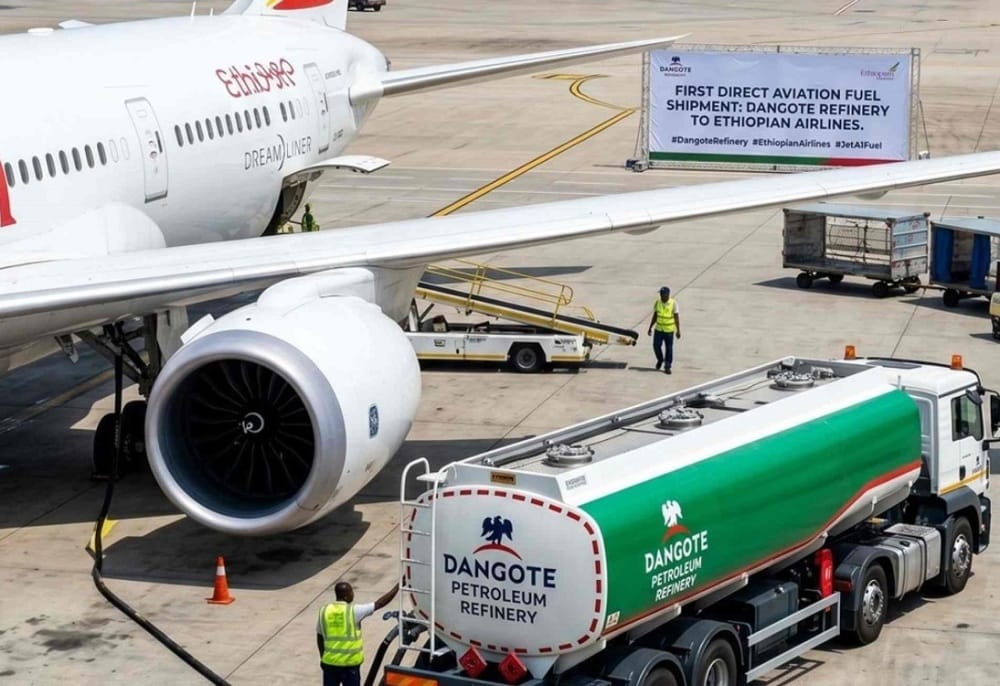
In recent months, soaring global aviation fuel prices — worsened by geopolitical uncertainty around the Strait of Hormuz and disruptions in global supply chains — have strengthened the strategic importance of the Nigerian site. The refinery has notably begun exporting Jet A1 to several African airlines, including Ethiopian Airlines, while also supplying some European markets seeking alternative sources of fuel. In March 2026, nearly 130,000 tonnes of aviation fuel produced by Dangote were reportedly shipped to the United Kingdom to prevent disruptions in British air traffic.
This expansion comes as African air traffic gradually returns to pre-pandemic levels. According to estimates by the International Air Transport Association (IATA), Africa is expected to record one of the strongest passenger traffic growth rates globally over the coming years, mechanically driving up kerosene consumption. Demand for aviation fuel across the continent is therefore expected to continue rising, fueled by the expansion of regional hubs, the growth of airlines, and the opening of new intra-African routes.
Yet behind this industrial success remain several challenges. Nigerian airlines continue to denounce what they describe as excessively high prices despite increased local supply. In April 2026, some carriers even threatened to suspend domestic flights due to soaring Jet A1 costs, arguing that middlemen were still artificially inflating prices.
Another vulnerability lies in crude oil supply. Dangote executives regularly complain about insufficient volumes of Nigerian crude to sustainably operate the refinery at full capacity. As a result, a significant share of the crude processed still has to be imported, exposing the group to international market fluctuations.
Despite these challenges, the Lekki petroleum complex already appears to represent a major turning point for African energy sovereignty. By securing an increasing share of the kerosene market, Dangote now aims to position Nigeria as a strategic hub for African refining and an essential supplier for regional air transport.


 Esther Grâce
 La voix des entreprises