

FINANCE : BCEAO–BEAC, Monetary Cooperation Gains Momentum in Digital Finance

(LVDE) – Meeting in Dakar on May 6, 2026, the governors of the Central Bank of West African States (BCEAO) and the Bank of Central African States (BEAC) strengthened their coordination around the modernization of payment systems and digital finance. Jean-Claude Kassi Brou and Yvon Sana Bangui reviewed the progress of their 2025–2026 joint roadmap, within the framework of a cooperation initiative launched in 2008 between WAEMU and CEMAC.
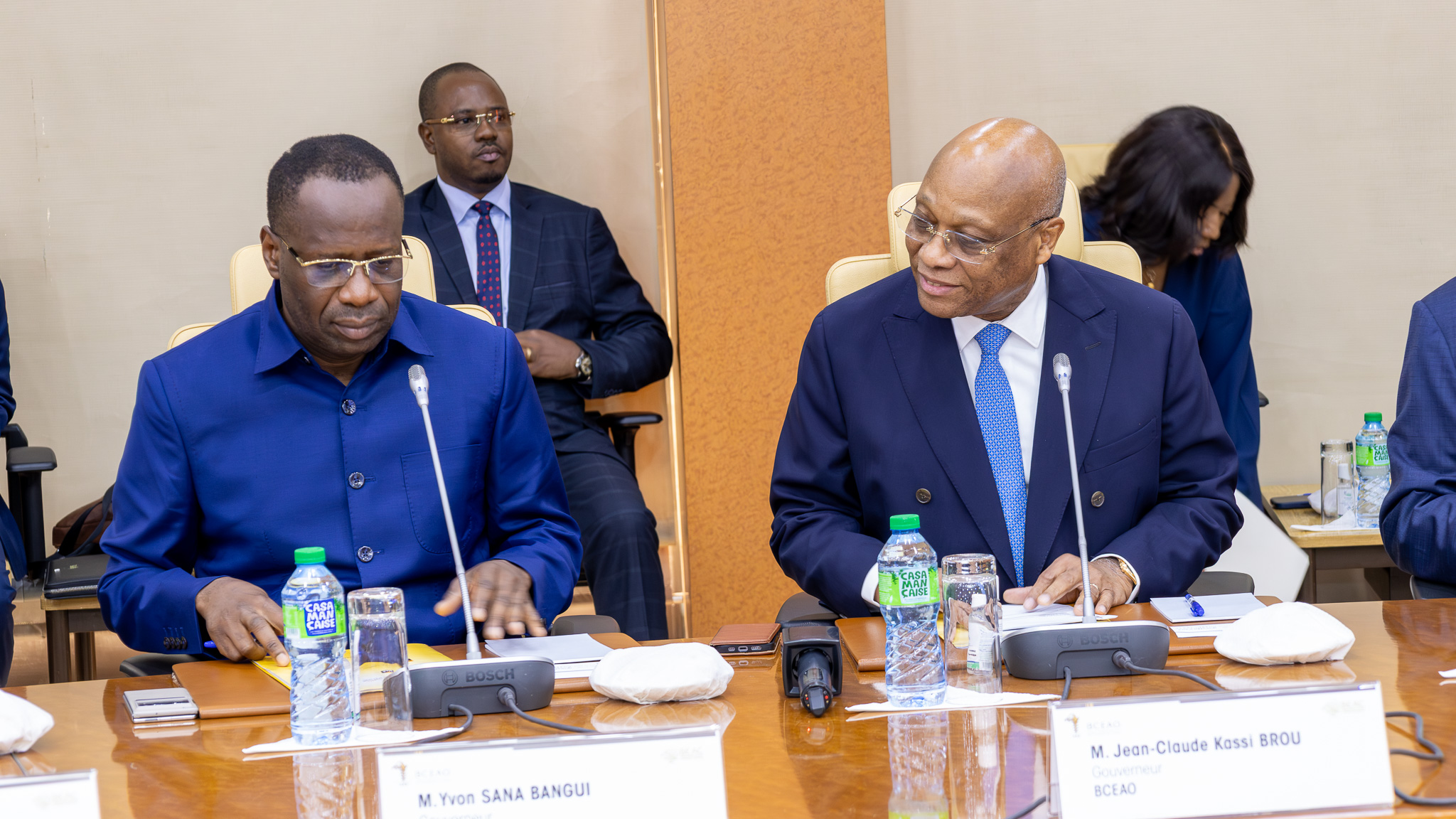
On the left, Yvon Sana Bangui, Governor of the BEAC; on the right, Jean-Claude Kassi Brou, Governor of the BCEAO.
In the quiet corridors of the BCEAO headquarters in Dakar, discussions between the two main monetary institutions of the CFA franc zone took on a more structured dimension, although without immediate operational announcements. The meeting between the governors of the BCEAO and the BEAC is part of a gradual effort to bring closer two economic areas that, despite sharing a common currency heritage, still largely operate in parallel.
At the heart of the exchanges are the profound transformations of Africa’s financial infrastructure. Both institutions reviewed ongoing projects related to the digitalization of banking services, the interoperability of payment platforms, and the strengthening of cybersecurity frameworks. These priorities have become central in a context marked by the rapid rise of fintech companies, the expansion of mobile money, and the need to secure increasingly digital financial flows.
According to information from the joint communiqué, the governors also assessed the progress of the 2025–2026 action plan adopted in Yaoundé, which aims to structure enhanced technical cooperation between the two central banks. This program covers several key areas, including financial inclusion, technological innovation, and the modernization of interbank payment infrastructure across both monetary zones, WAEMU and CEMAC.
This convergence comes amid a challenging macroeconomic environment. Both subregions face similar pressures: volatile commodity prices, imported inflation, and increasing financing needs for national economies. In this context, the modernization of financial systems is seen as a key lever to improve capital circulation and support growth.
Data from international financial institutions show that digital payments are expanding rapidly across Sub-Saharan Africa, driven largely by the widespread use of mobile phones as primary banking tools. In several countries in the region, mobile money transactions now account for a significant share of both formal and informal financial flows, pushing central banks to adapt their regulatory frameworks accordingly.
However, the Dakar meeting did not result in new concrete measures. Both parties opted instead for a consolidation of existing achievements, emphasizing continuity in ongoing technical work. This cautious approach reflects the complexity of harmonizing two distinct monetary areas, despite a shared currency heritage and converging economic challenges.
Beyond technical considerations, the BCEAO and the BEAC reaffirm a broader ambition: to make their cooperation a driver of regional financial integration. This orientation aligns with the objectives of WAEMU and CEMAC, which aim to strengthen monetary stability and facilitate intra-African trade in a context of fragmented financial markets.
The next step in this process has already been set. Both institutions agreed to meet again in 2027 at the BEAC headquarters to review progress on their joint program. In the meantime, technical teams will continue working on harmonizing payment systems and assessing ongoing reforms, in an environment where digital transformation continues to reshape the contours of African finance.

 Esther Grâce
 La voix des entreprises