

CSTAR REFINERY : BGFIBank Cameroon mobilizes CFA 120 billion financing with a local banking pool

(LVDE) – In Yaoundé, on 5 May 2026, the National Hydrocarbons Corporation (SNH) and BGFIBank Cameroon signed a CFA 120 billion financing agreement dedicated to the CSTAR refinery project. The operation, carried out in partnership with Afriland First Bank, CCA-Bank, SCB Cameroon and BICEC, aims to strengthen Cameroon’s refining capacity and reduce its dependence on imported petroleum products.
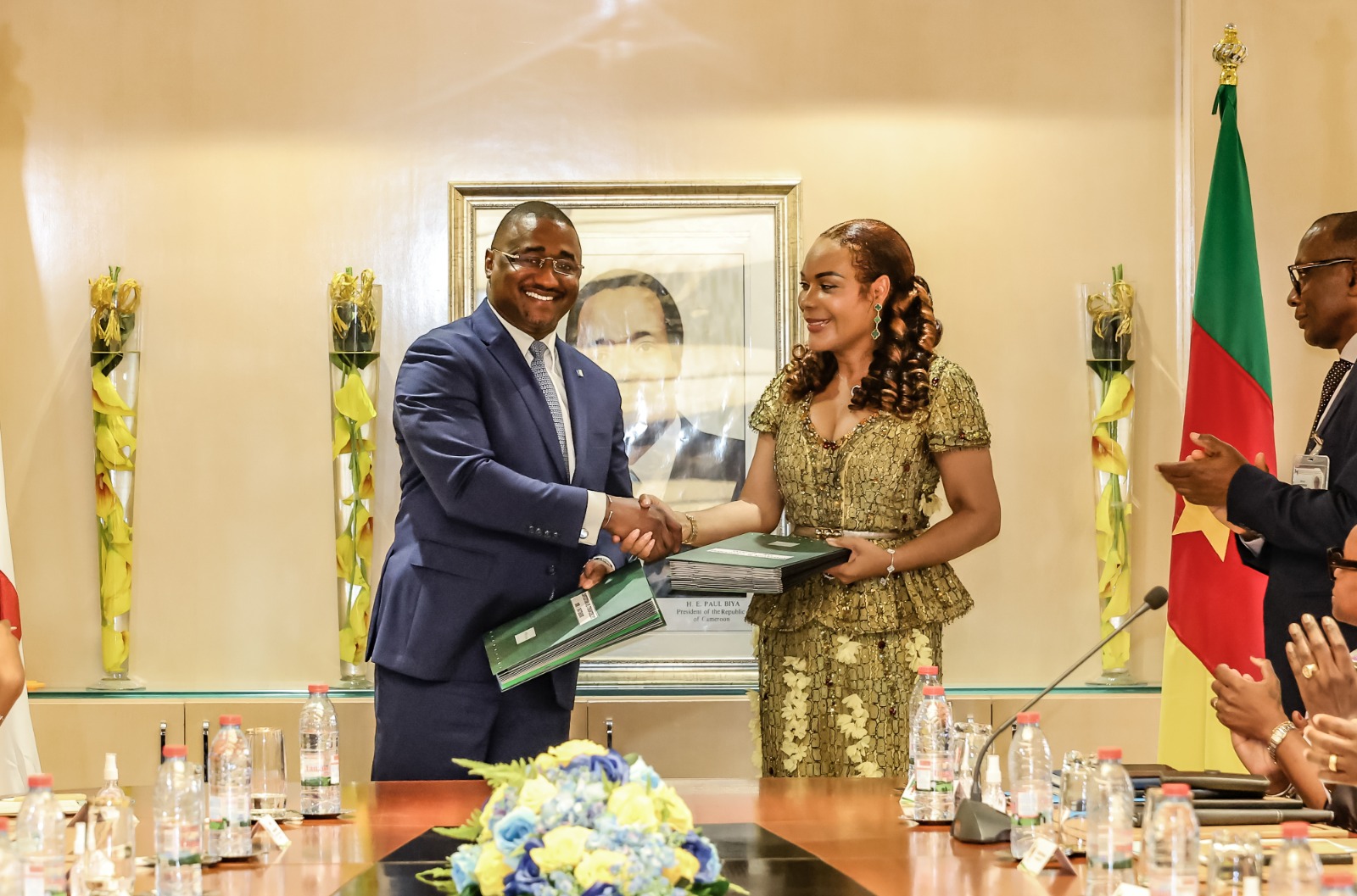
Abakal Mahamad, CEO of BGFIBank Cameroon, and Nathalie Moudiki, representative of the Managing Director of SNH.
Inside the quiet, secure premises of SNH headquarters in Yaoundé, the atmosphere was both formal and highly strategic on that 5 May 2026. Around the table, banking executives, public sector managers and technical partners gathered to seal a decisive milestone in a major energy project. Conversations were restrained but purposeful, reflecting the weight of the objective : securing financing for a refinery expected to reshape Cameroon’s energy landscape.
The signing ceremony between Adolphe Moudiki, Managing Director of SNH, and Abakal Mahamat, CEO of BGFIBank Cameroon, marks the culmination of a process initiated six months earlier. Through this arrangement, the bank successfully assembled a financing pool including Afriland First Bank, CCA-Bank, SCB Cameroon and BICEC, underscoring the strong involvement of the domestic banking sector in this large-scale industrial project.
The funding represents SNH’s direct contribution to the construction of the CSTAR refinery, alongside its strategic partner Ariana Energy. The project is part of a broader industrialisation drive aimed at locally processing petroleum resources and reducing reliance on imported fuel products. Once operational, the refinery is expected to produce around 1.8 million metric tons annually, representing a significant share of national consumption.
From a macroeconomic perspective, projections highlight substantial gains. The reduction in fuel imports is estimated at nearly USD 750 million per year (about CFA 435 billion), covering roughly 30% of national demand. In addition, projected exports of marine fuel could generate around USD 250 million annually, while foreign exchange savings are expected to exceed CFA 580 billion. In a context of pressure on foreign reserves, these figures give the project a strong strategic dimension.
Industrial design also follows a modular approach, allowing phased expansion. The first output phase is expected in December 2026 with an initial capacity of 10,000 barrels per day, before scaling up to 30,000 barrels per day by 2028. This gradual ramp-up is intended to secure investment efficiency while ensuring infrastructure readiness.
Beyond the financial structure, the initiative reflects a broader shift in how major projects are financed in Cameroon. The reliance on a local banking consortium signals a growing capacity to mobilise domestic capital, while reducing dependence on external funding sources. The Bank of Central African States (BEAC) has also expressed readiness to support the project, stressing its importance for regional monetary stability.
Meanwhile, other components of the project are advancing, including the construction of a storage terminal (tank farm), fully financed by SNH. Together, these elements form an integrated value chain from storage to refining, reinforcing national energy sovereignty.
As implementation phases approach, expectations remain high. Beyond import substitution and foreign exchange savings, the project is expected to generate around 5,000 jobs during construction and approximately 200 permanent positions during operation. It is a significant contribution in a context where industrialisation remains central to Cameroon’s economic policy.
With this financing milestone, the CSTAR refinery project moves a step closer to execution. The challenge now lies in translating financial commitments into tangible delivery, in a sector where energy, industrial and financial stakes are deeply interconnected.

 La voix des entreprises
 Esther Grâce