

MARITIME TRANSPORT : GULFCAM’s Kribi–Douala cabotage project remains stalled despite strong economic expectations

(LVDE) – The CAMSHIP maritime cabotage service, operated by the national shipping company GULFCAM, has remained partially inactive for several weeks on the Kribi–Douala route in Cameroon. Moored off the port of Kribi, a multipurpose cargo vessel is still awaiting the effective launch of its rotations, although customs and administrative procedures have already been validated. Launched in November 2025, this strategic scheme aims to organize regular container transport between the country’s two main ports, in a context of growing activity at the Kribi deep-sea port and the gradual structuring of national cabotage.

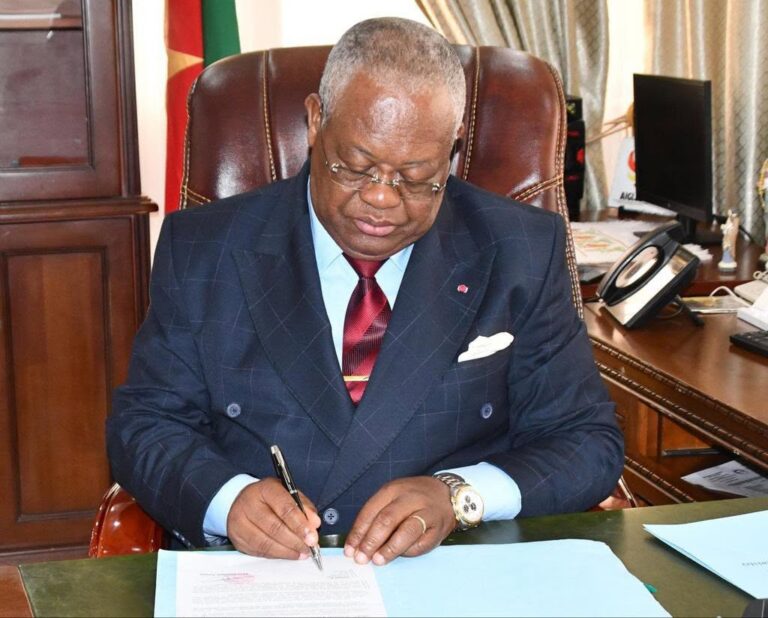
Perrial Jean Nyodog, président de l’entreprise camerounaise Gulfcam.
Off the Kribi deep-sea port, the imposing silhouette of a multipurpose cargo vessel stands in contrast to the intense activity of the port terminals. While cranes continue loading operations and trucks move steadily along logistics corridors, the vessel has remained idle for several weeks, awaiting its operational deployment. Around the CAMSHIP project, technical and administrative discussions are still ongoing between operators, port authorities and relevant government departments.
Behind this waiting period lies one of the most ambitious logistics projects undertaken in recent years by a Cameroonian maritime operator. Through CAMSHIP, GULFCAM—successor to Cameroon Shipping Lines created in 1974—aims to ensure regular container rotations between Kribi and Douala. The service plans several monthly departures and could eventually handle several thousand twenty-foot equivalent units (TEUs), helping to ease national trade flows.
The system primarily targets containers cleared in Kribi but destined for Douala, which are currently transported almost exclusively by road. It also concerns cargo from major international shipping lines as well as the needs of industries located along Cameroon’s coastal corridor, seeking more competitive logistics alternatives.
In port circles, the project is seen as a potential driver of economic transformation. Its operational launch could generate direct jobs in maritime, port and logistics activities, while creating a ripple effect across the entire transport chain. Several observers also believe that a regular maritime link between Kribi and Douala would enhance Cameroon’s industrial attractiveness.
Expected fiscal benefits also represent a key issue. Port taxes, handling fees and various levies could generate additional revenue for the State, port authorities and local governments. In this context, the vessel’s prolonged inactivity is viewed as a loss of potential income for several economic stakeholders.
However, project promoters stress that CAMSHIP is not intended to compete with major international shipping lines operating along the West African coast. Instead, the service is designed to perform a local redistribution function between national ports. Discussions have already been initiated with several shipping companies to explore cooperation mechanisms.
Under the supervision of Cameroon’s Ministry of Transport, authorities are currently working on structuring the cabotage market, with the aim of ensuring balance among operators and securing the viability of the national system.
Despite current delays, several encouraging signals remain. Customs procedures have already been completed, and some industrial operators have expressed readiness to use the service as soon as it becomes operational. In logistics circles, many voices now argue that it is urgent to remove the technical and operational bottlenecks still delaying the CAMSHIP project, so that the vessel already moored in Kribi can finally enter service and deliver the expected logistics, employment and public revenue benefits to the Cameroonian economy.


 La voix des entreprises
 Esther Grâce