

DOUALA PORT AUTHORITY : 4.1% Revenue Growth in 2025 Amid Accounting Pressures in the PAD Group

(LVDE) – Meeting in Douala from May 18 to 21, 2026, the Board of Directors of the Douala Port Authority (PAD) approved the standalone and consolidated financial statements for the 2025 fiscal year, under the chairmanship of Shey Jones Yembe. The results presented by the General Management, led by Cyrus Ngo’o, show a 4.1% increase in standalone revenue and a 16% rise in net profit, confirming the institution’s growth trajectory despite a decline in consolidated group results linked to accounting and tax-related impacts on its subsidiary RTC.

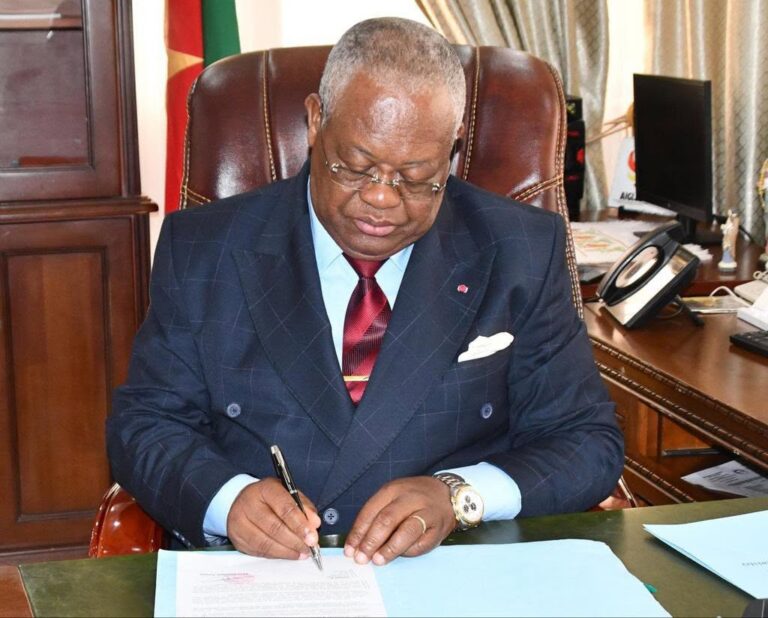
Cyrus Ngo’o, Managing Director of the Autonomous Port of Douala (PAD).
In a context of heightened scrutiny of the performance of public enterprises, the Douala Port Authority held its 130th, 131st, and 132nd Board sessions on May 18, 19, and 21, 2026. Presented by Director General Cyrus Ngo’o, the 2025 financial statements confirm an overall positive momentum for the port, a strategic pillar of Cameroon’s economy and the country’s main logistics hub.
Standalone accounts show revenue of FCFA 74.896 billion, compared to FCFA 71.956 billion in 2024, representing an increase of FCFA 2.940 billion (+4.1%). Net profit also rose from FCFA 6.242 billion to FCFA 7.268 billion, up 16%. According to management, these results reflect improved port activity and better control of operating costs in a competitive regional logistics environment.
On a consolidated basis, the PAD Group recorded revenue of FCFA 119.616 billion, up from FCFA 114.199 billion in 2024, a 5% increase. However, consolidated net profit fell to FCFA 5.664 billion from FCFA 12.567 billion a year earlier, a 55% decline. This contraction is mainly attributed to exceptional accounting effects affecting RTC, following a tax reassessment estimated at over FCFA 12 billion.
Internal explanations indicate that RTC was required to provision a significant portion of this tax adjustment pending the outcome of ongoing litigation, which mechanically weighed on the group’s consolidated earnings. At the same time, the subsidiary’s turnover continued to grow, confirming sustained operational activity despite the accounting impact. PAD officials emphasize the importance of distinguishing between the parent company’s standalone accounts and the group’s consolidated accounts to avoid misinterpretation of overall performance.
In its communications, the Douala Port Authority stresses that its core indicators remain on an upward trend and rejects interpretations suggesting a structural decline in performance. The institution insists that its results must be analyzed within a rigorous accounting framework, in a context where the complexity of consolidated structures can lead to public misunderstanding.
Beyond the financial figures, the Board reviewed several strategic issues, including tariff policy, human resources management, public procurement procedures, and the progress of key infrastructure projects such as the modernization of the Boscam quay and the development of the port railway network. Discussions also covered ongoing negotiations with international partners, including JAN DE NUL and CREDENDO, as part of infrastructure modernization efforts.
The Board also approved the 2025 social report and performance report, as well as the group’s financial statements. PAD’s total balance sheet stands at FCFA 529.26 billion, with pre-tax earnings of FCFA 14.09 billion. At the end of the sessions, the Board Chairman commended the efforts of management and staff, highlighting the modernization drive and competitiveness of the Douala-Bonabéri Port, the main maritime gateway for Cameroon and the sub-region.
In an environment marked by regional port competition and increasing demands from global logistics chains, PAD aims to strengthen its strategic position through infrastructure modernization, digital transformation of procedures, and improved operational performance—a trajectory the institution describes as broadly stable and geared toward sustainable growth.


 La voix des entreprises
 Esther Grâce