


TIMBER INDUSTRY : Cameroon Accelerates its Local Processing Strategy and Tightens log Export Restrictions

(LVDE) – On April 28, 2026, in Yaoundé, Cameroon’s Minister of Forestry and Wildlife, Jules Doret Ndongo, signed a decree increasing to 91 the number of timber species banned from export in log form. This new phase of Cameroon’s forestry policy aligns with the CEMAC strategy aimed at completely phasing out raw timber exports by 2028, with the objective of strengthening local industrialization and increasing value creation within the timber industry.
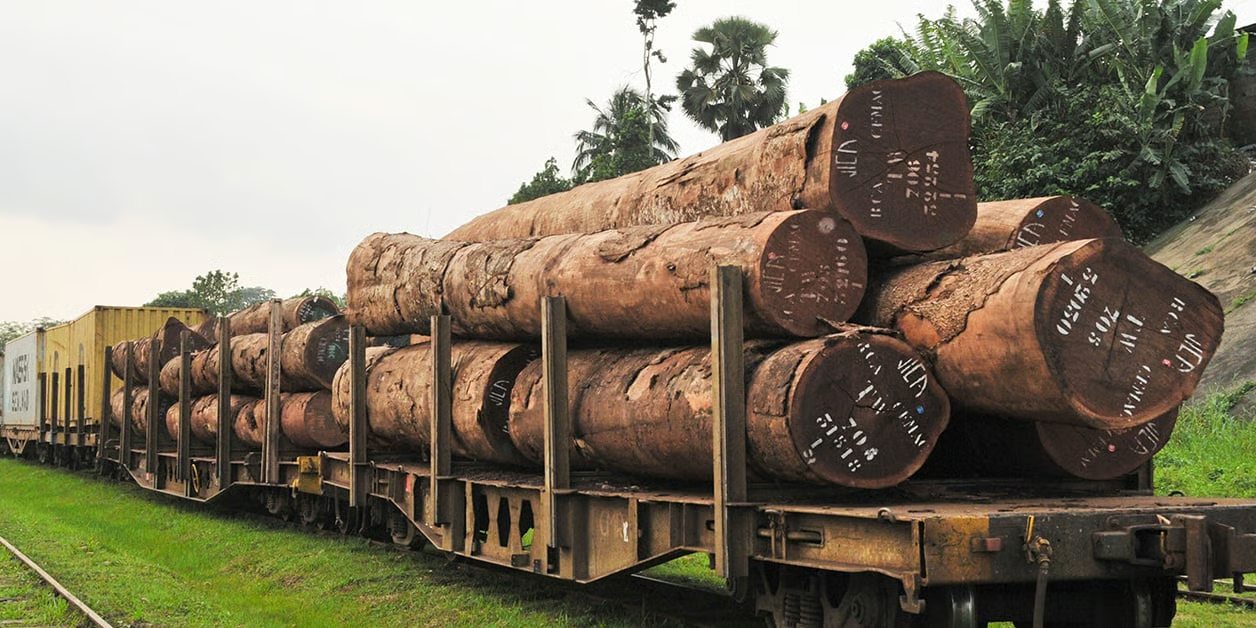
Cameroon is gradually tightening its forestry and industrial policy. By expanding the list of species prohibited from being exported as raw logs, Yaoundé is reaffirming its ambition to fundamentally transform a timber economy long dominated by low-value raw material exports. The decree signed on April 28, 2026 by Minister Jules Doret Ndongo marks another step toward a more integrated and value-added local wood-processing industry.
From now on, 91 timber species will no longer be allowed to leave Cameroon in raw log form, up from 76 previously. Only 23 so-called “promotion species” remain eligible for export under specific conditions, subject to an additional tax on unprocessed forest products. The framework distinguishes 14 first-category species and 9 second-category species, while Azobé, also known as Bongossi, is now subject to a special regime based on export quotas allocated directly by the forestry administration.
This policy direction is part of a broader regional strategy led by CEMAC member states and the Democratic Republic of Congo. During a ministerial meeting held in Bangui in February 2024, forestry ministers adopted a gradual roadmap toward a total ban on log exports by January 1, 2028. Since January 2025, countries across the sub-region have already begun implementing phased restrictions aimed at promoting domestic timber processing.
Beyond regulation, the stakes are fundamentally economic. The Cameroonian government seeks to shift a sector historically dependent on raw timber exports toward higher-value industrial activities such as sawing, veneer production, plywood manufacturing, furniture making, and other processed wood products. To accelerate this transition, export duties on logs were significantly increased, rising from 17.5% in 2017 to 75% of FOB value in 2024. At the same time, fiscal incentives have been introduced to support companies investing in local wood-processing facilities.
This strategy is already beginning to reshape foreign trade statistics. According to data compiled from the National Institute of Statistics’ 2025 report, Cameroon’s log exports fell to 349,611 tons in 2025, down from more than 450,000 tons the previous year. This marks the lowest level recorded over the past five years. Conversely, exports of sawn timber and semi-processed wood products continue to increase, reflecting the growing importance of first-stage processing within the country’s export structure.
However, this industrial transition still faces major challenges. Industry operators point to high energy costs, logistical shortcomings, limited access to financing, and insufficient industrial infrastructure capable of absorbing the full volume of timber previously exported in raw form. Authorities must also strengthen traceability and enforcement mechanisms to prevent tighter restrictions from fueling illegal trafficking and forestry smuggling networks.
As the 2028 deadline approaches, Cameroon is making a strategic economic choice: progressively reducing its dependence on unprocessed raw material exports in order to build a stronger forestry industry capable of generating more jobs, tax revenues, and local added value. A transformation that could significantly reshape the timber economy of Central Africa in the years ahead.


 La voix des entreprises
 Esther Grâce