

CAMEROON : Kribi Port Invests CFAF 3.5 Billion to Prepare for the Arrival of New Industrial Players

(LVDE) – On May 7, 2026, the Port Authority of Kribi (PAK) launched a national tender in Kribi to develop an additional 20 hectares within the Mboro port zone. Valued at CFAF 3.5 billion, the project aims to strengthen the industrial and logistics infrastructure of the port complex in order to accommodate new investors, amid the accelerated rollout of the Kribi Port Industrial Zone (KPIZ).

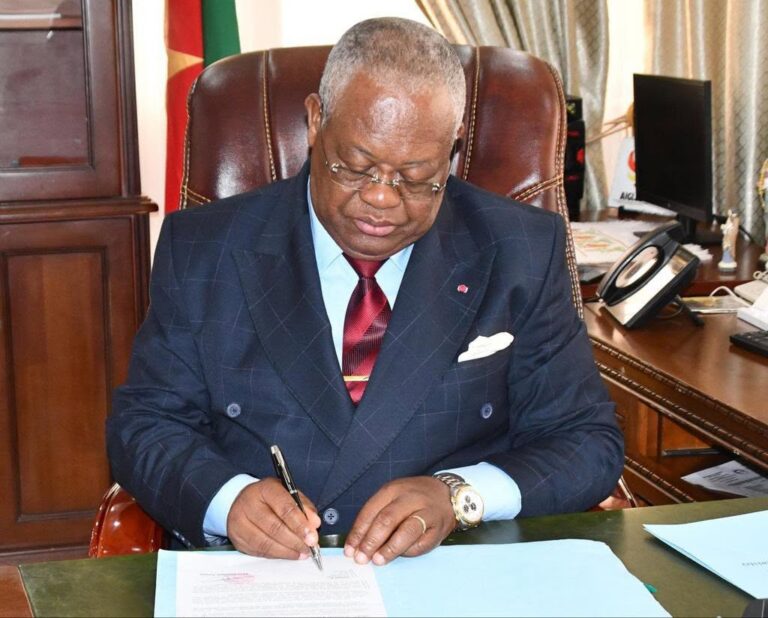
Patrice Melom, Director General of the Port Authority of Kribi (PAK)
In Kribi, along Cameroon’s southern Atlantic coastline, construction machinery and large-scale infrastructure projects continue to reshape the country’s leading industrial and maritime hub. On May 7, 2026, the Port Authority of Kribi (PAK) officially launched a national tender for the development of 20 additional hectares in the Mboro port area, marking another milestone in the expansion strategy of the deep-sea port complex.
Estimated at nearly CFAF 3.5 billion and financed through PAK’s 2026–2028 triennial budget, the project includes the construction of key infrastructure designed to improve the attractiveness and operational readiness of the site. According to tender documents released by the port authority, the works will involve the installation of a 30 KV overhead power network with transformer stations, underground power supply systems, potable water distribution infrastructure, as well as digital connectivity solutions including fiber optics, radio links and secure telecommunications systems.
The program also covers the construction of road networks, sidewalks, stormwater drainage systems, wastewater treatment facilities and the installation of autonomous solar-powered street lighting. The objective is to transform this section of the port estate into a fully serviced industrial platform capable of immediately hosting logistics operators, manufacturing companies and service providers seeking to establish operations in Kribi.
Beyond the infrastructure works, the initiative reflects the authorities’ determination to respond to growing investor demand. Despite an extensive land reserve estimated at around 15,000 hectares dedicated to heavy industry, light manufacturing and service activities, the Port of Kribi continues to face development bottlenecks that limit its current hosting capacity. To date, only 196 hectares are effectively operational, representing less than 2% of the available land potential. Sources: Port Authority of Kribi, Public Contracts Regulatory Agency (ARMP).
This situation has created increasing pressure from economic operators interested in the deep-water port. According to figures published by ARMP, nearly 150 installation requests have already been submitted, yet only 48 Temporary Occupation Authorizations have been granted so far due to the insufficient availability of serviced industrial land.
The development of the additional 20 hectares in Mboro is also part of the broader Kribi Port Industrial Zone (KPIZ) project officially launched on February 26, 2026 in Yaoundé. This flagship program plans the development of 4,000 hectares of integrated industrial land within the port area, with the ambition of creating one of Central Africa’s largest industrial hubs.
The consortium in charge of the project brings together several major logistics and industrial players, including Africa Global Logistics, Arise Integrated Industrial Platforms and Belmont Investments alongside the Port Authority of Kribi. Total investment for the project is estimated at nearly €795 million, equivalent to more than CFAF 520 billion. The African Development Bank is expected to provide €411 million in public financing, complemented by approximately €384 million in private-sector funding.
At a time when several African countries are seeking to develop integrated industrial corridors around their port infrastructure, Cameroon is positioning Kribi as a regional platform capable of attracting mining, metallurgical, agro-industrial and logistics investments. Thanks to its deep-water port infrastructure designed to accommodate large-capacity vessels, Kribi is increasingly viewed as one of the country’s main drivers of industrial transformation and regional economic integration.
For Cameroonian authorities, accelerating infrastructure works in Mboro is intended to rapidly address investor demand while awaiting the full deployment of the KPIZ project. The strategy underscores Cameroon’s ambition to transform the Port of Kribi into a central engine of national industrialization and a strategic gateway for Central African trade.

 La voix des entreprises
 Esther Grâce