

CAMEROON : AGL and CAMALCO Lay the Foundations for the Édéa–Kribi–Lolabé–Campo Rail Corridor

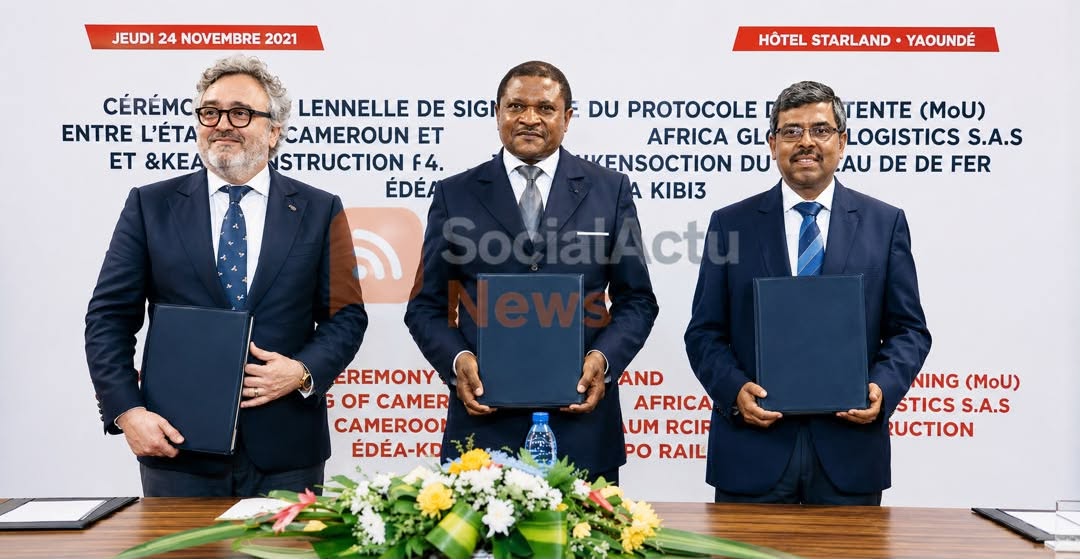
(LVDE) – In Yaoundé on June 4, 2026, the State of Cameroon and the consortium made up of Africa Global Logistics (AGL) and CAMALCO Cameroon S.A. signed a memorandum of understanding for the construction of the Édéa–Kribi–Lolabé–Campo railway line. This public-private partnership paves the way for the development of a strategic corridor aimed at strengthening national logistics and the country’s industrial integration.
Beyond the formal signing, this agreement establishes the central role entrusted to Africa Global Logistics and CAMALCO in structuring a 185-kilometer railway corridor expected to transform transport flows in Cameroon. The project is aligned with the priorities of the National Development Strategy 2020–2030 (SND30), which places infrastructure at the heart of economic competitiveness.
The partnership framework defines a clear division of responsibilities. AGL and CAMALCO will be responsible for updating studies, arranging financing, carrying out construction works, as well as operating and maintaining the future line. The State, for its part, will ensure strategic oversight and overall project coordination.
The signing ceremony, held at the Star Land Hotel in Yaoundé, brought together government representatives, officials from the Kribi Autonomous Port (PAK), as well as public and private stakeholders from the logistics and infrastructure sectors. This broad participation reflects the growing interest of economic operators in large-scale structural projects amid the ongoing transformation of regional supply chains.
For Africa Global Logistics, a leading transport and logistics player in Africa, the corridor is part of a broader strategy to expand multimodal networks connecting ports, industrial zones, and inland regions. CAMALCO, meanwhile, strengthens its position in the development of capital-intensive strategic infrastructure projects.
The project builds on the growing performance of the Kribi Autonomous Port, which handled more than 555,000 TEUs and 12.7 million tons of cargo in 2025. This upward trend calls for rapid adaptation of land transport infrastructure to ease flows and improve the country’s logistics competitiveness.
In this context, the future railway line is seen as a key performance driver, expected to reduce transport costs, improve delivery times, and strengthen connectivity between the industrial areas of Édéa and the port facilities of Kribi.
Beyond its economic dimension, the project also aims to enhance territorial integration by structuring new development hubs in the southern region. For the companies involved, it also represents a strategic opportunity in an African market where logistics is becoming a decisive competitiveness factor.
With this memorandum of understanding, Cameroon and its private partners take a key step toward the realization of a railway corridor expected to significantly reshape the country’s logistics landscape.

 La voix des entreprises
 Esther Grâce