

FOREIGN TRADE : Cameroon bets on a Single Maritime Window to boost competitiveness

(LVDE) – Meeting on 25 and 26 May 2026 in Douala, Cameroonian administrations in charge of transport, customs and port operations examined the framework of the future Single Maritime Window (SMW). This digital platform aims to centralise procedures related to ship calls, reduce processing times and enhance the competitiveness of the ports of Douala and Kribi.

Cameroon is seeking to take a new step in modernising its foreign trade. In Douala, the country’s main economic hub, the work of the interministerial committee dedicated to the establishment of the Single Maritime Window highlighted a clear ambition : simplify port procedures, speed up vessel turnaround times and strengthen the attractiveness of national maritime infrastructure in an increasingly competitive regional environment.
Concretely, the future system is designed to centralise all administrative formalities related to vessel calls on a single digital platform. Today, shipowners, freight forwarders, port authorities, customs services, border police and other agencies often operate through separate procedures, generating duplication, delays and additional costs. The Single Maritime Window aims to end this fragmentation by enabling a smooth and secure flow of information between all actors in the logistics chain.
One of the main stated objectives is to reduce vessel processing time to under 24 hours. This has become a benchmark in several competitive port hubs worldwide. For economic operators, every hour saved translates into lower logistics costs and improved trade efficiency. In a context where international trade increasingly depends on speed and predictability, digitalisation is emerging as a key lever of competitiveness.
This reform also aligns with Cameroon’s international commitments. The country is a signatory to several maritime conventions encouraging the dematerialisation of port procedures and the electronic exchange of data. The Single Maritime Window thus responds to International Maritime Organization recommendations aimed at harmonising and simplifying administrative formalities in ports to facilitate global trade.
For the authorities, the challenge goes beyond administrative efficiency. It is also about strengthening the position of the ports of Douala and Kribi in regional logistics competition. As several African countries invest heavily in port and digital infrastructure, service quality has become a decisive factor in attracting international shipping lines and trade flows. The deep-water port of Kribi and the port of Douala, the main gateway for goods in the sub-region, are directly concerned by this transformation.
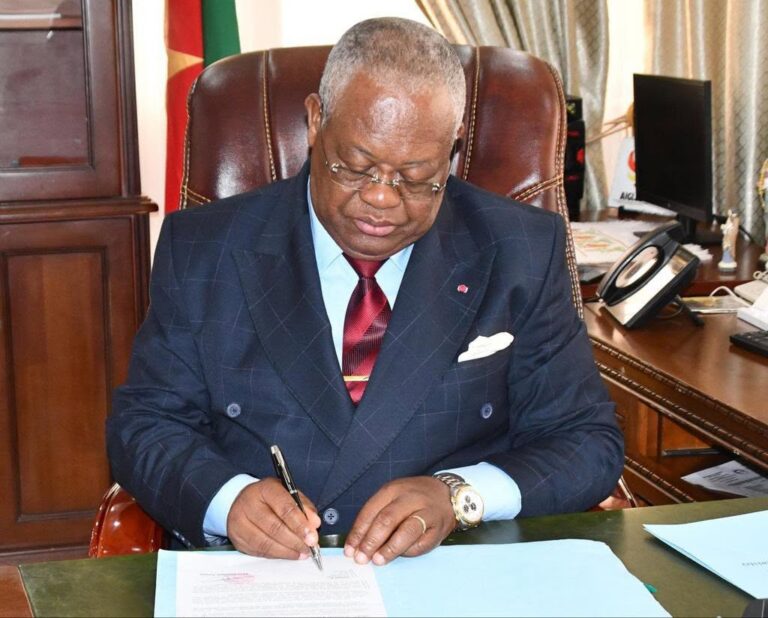
Opening the proceedings, Mveimani Sombo Amba described the project as a “decisive turning point” for the national port system. According to him, the evolution of international trade now imposes higher requirements in terms of speed, traceability and efficiency, which Cameroon must meet in order to preserve its competitiveness.
Beyond procedural modernisation, the Single Maritime Window could also improve operational transparency, reduce risks of documentary fraud and optimise revenue linked to port activities. In the long term, this platform is expected to become one of the pillars of Cameroon’s digital transformation of foreign trade, with the ambition of bringing the country’s logistics performance closer to international standards.


 La voix des entreprises
 Esther Grâce