

INDUSTRY : CSTAR Refinery Project in Kribi Secures Support from the National Assembly

(LVDE) – On May 26, 2026 in Yaoundé, the Speaker of the National Assembly, Théodore Datouo, expressed his support for the CSTAR refinery project led by SNH during a meeting with Nathalie Moudiki, on the sidelines of a protocol visit by women from the company. The investment, estimated at over 540 billion CFA francs, thus reaches a new institutional milestone.
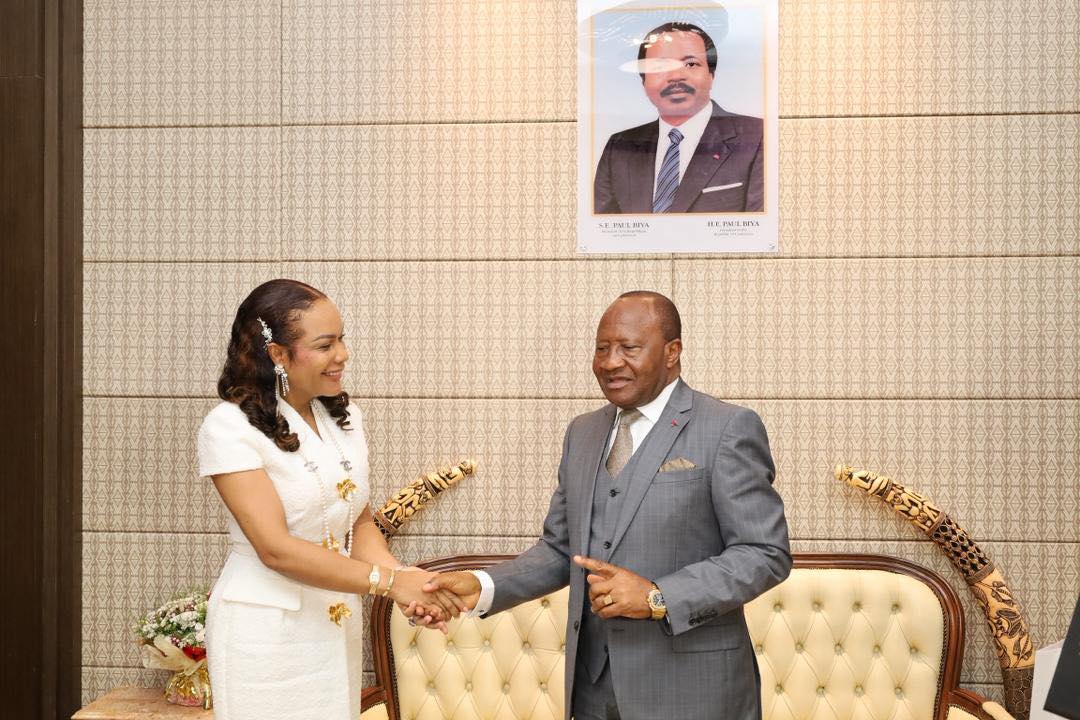
Handshake between Théodore Datouo, President of the National Assembly, and Nathalie Moudiki, Advisor No. 2 at SNH and Chairperson of the project's Board of Directors.
Inside the Palais des Verres Paul Biya, the official sequence, organized as part of Mother’s Day activities, provided the setting for a discussion with major strategic implications. Beyond its ceremonial nature, the meeting brought the CSTAR project back to the center of attention, as it is seen as one of the pillars of Cameroon’s future refining infrastructure.
Receiving Nathalie Moudiki, SNH’s Deputy CEO and Chair of the project’s Board of Directors, Théodore Datouo praised a structuring initiative. For the head of the lower house of Parliament, “thinking about a refinery is thinking about national development.” This stance provides explicit political backing to the project led by the SNH–Tradex–Ariana Energy consortium.
Located on approximately 250 hectares in the Kribi industrial-port zone, the future refinery is part of a broader strategy of energy sovereignty and industrial integration. The project includes a refining unit valued at around 360 billion CFA francs, combined with a strategic storage terminal estimated at over 540 billion CFA francs. The terminal will have a capacity of 250,000 to 300,000 m³ of petroleum products, including diesel, gasoline, Jet A1, kerosene, and heavy fuel oil (HFO).
On the financing side, a key milestone was reached in early May 2026. A banking consortium led by BGFIBank Cameroon, alongside Afriland First Bank, CCA Bank, SCB Cameroon, and BICEC, mobilized 120 billion CFA francs to support SNH’s participation. This operation strengthens the financial structuring of the project, which is still in its scaling-up phase.
The industrial timeline foresees a first commissioning in December 2026, with an initial capacity of 10,000 barrels per day. Output is expected to gradually increase to 30,000 barrels per day within 24 months, representing about 1.5 million metric tons annually. In the long term, CSTAR aims to reduce petroleum product imports by up to 30%, generating estimated savings of around 750 million USD per year.
The project also carries a strong social dimension. During the construction phase, nearly 5,000 direct and indirect jobs are expected, compared to around 2,000 permanent jobs once operational. This reinforces its status as a major industrial project in an economy still heavily reliant on energy imports.
In this context, parliamentary support appears as an important institutional signal. It could facilitate the regulatory and budgetary adjustments needed to advance the project, in an environment where large energy investments remain sensitive to financing constraints.
In Kribi, CSTAR is increasingly positioning itself as a cornerstone of Cameroon’s petroleum strategy. Between industrial ambition and sovereignty stakes, the project is moving forward under strong institutional scrutiny, with the goal of sustainably reshaping the country’s energy value chain.
Esther Grace

 La voix des entreprises
 Esther Grâce