

INDUSTRIALIZATION : Telcar Cocoa secures CFA 9 billion from BGFIBank Cameroon for a new plant in Douala

(LVDE) – On April 10, 2026, in Douala, Kate Fotso, CEO of Telcar Cocoa, and Abakal Mahamat, Managing Director of BGFIBank Cameroon, signed a CFA 9 billion financing agreement for the construction of an industrial unit in Souza, in the Littoral region, aimed at strengthening local processing and supporting Cameroon’s industrialization drive.
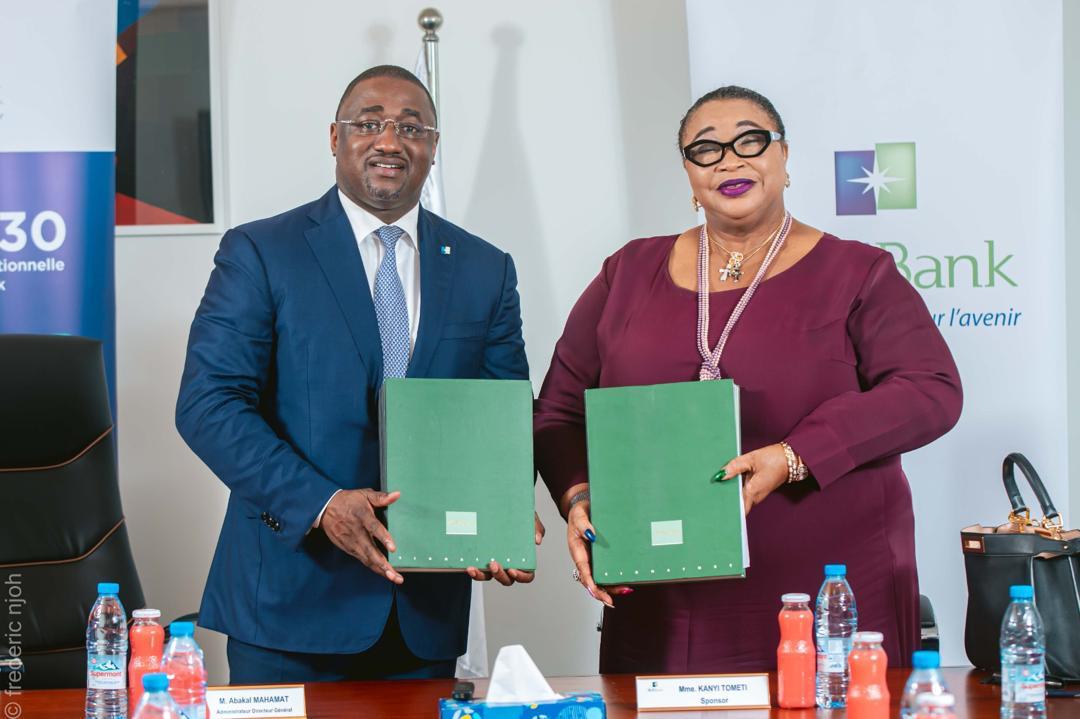
Abakal Mahamat, Managing Director of BGFIBank Cameroon, and Kate Fotso, CEO of Telcar Cocoa.
In a context marked by public authorities’ efforts to accelerate the structural transformation of the economy, this financing agreement stands as a strong signal in favor of industrial development. At the headquarters of BGFIBank Cameroon, both parties formalized a strategic partnership paving the way for the construction of a large-scale industrial complex in Souza, a locality located near Douala, the country’s main economic hub.
Led by Telcar Cocoa, a company historically active in the cocoa sector, the project represents a major step in the diversification of its activities. The planned facility will host a beverage production unit designed in compliance with environmental standards and current sustainability requirements. Through this investment, the company aims to broaden its industrial footprint while contributing to upgrading local production.
Beyond its industrial scope, the initiative is expected to generate significant socio-economic impact. Projections indicate around 450 direct jobs upon commissioning of the plant, along with nearly 3,000 indirect jobs. These opportunities will span supply chains, logistics, distribution, and related services, thereby strengthening the local economic fabric.
For BGFIBank Cameroon, this operation is part of a clear strategy of financing productive sectors. Over the years, the banking institution has increasingly directed its credit portfolio toward agriculture, manufacturing, and infrastructure, seen as key drivers of growth. This approach aims to support high-impact projects capable of generating added value and reducing the country’s reliance on imports.
The choice of the beverages sector reflects this dynamic. In Cameroon, demand for processed products continues to rise due to urbanization and changing consumption patterns. According to data from the National Institute of Statistics, a significant share of these products is still imported, widening the trade deficit. The development of local industrial units therefore appears as a concrete response to the import-substitution policy promoted by public authorities.
By engaging in this structuring project, Telcar Cocoa and BGFIBank Cameroon contribute to the consolidation of a more resilient industrial ecosystem. This initiative also reflects the growing role of domestic private actors in the country’s economic transformation, in a context where investment needs remain substantial.
Through this new industrial unit, Cameroon takes another step toward diversifying its productive base. Between job creation, local resource valorization, and import reduction, the Souza project is fully aligned with the country’s industrial development ambitions.

 La voix des entreprises
 Esther Grâce