

CORPORATE SOCIAL RESPONSIBILITY (CSR) : Kribi Port Strengthens Its Community Commitment with Helen Keller

(LVDE) – On June 1, 2026, in Yaoundé, the Kribi Autonomous Port (PAK) and the international NGO Helen Keller International signed a three-year memorandum of understanding aimed at improving the health conditions of communities living around the port area. The partnership will focus on combating preventable blindness, malnutrition, and neglected tropical diseases as part of the port authority’s corporate social responsibility strategy.
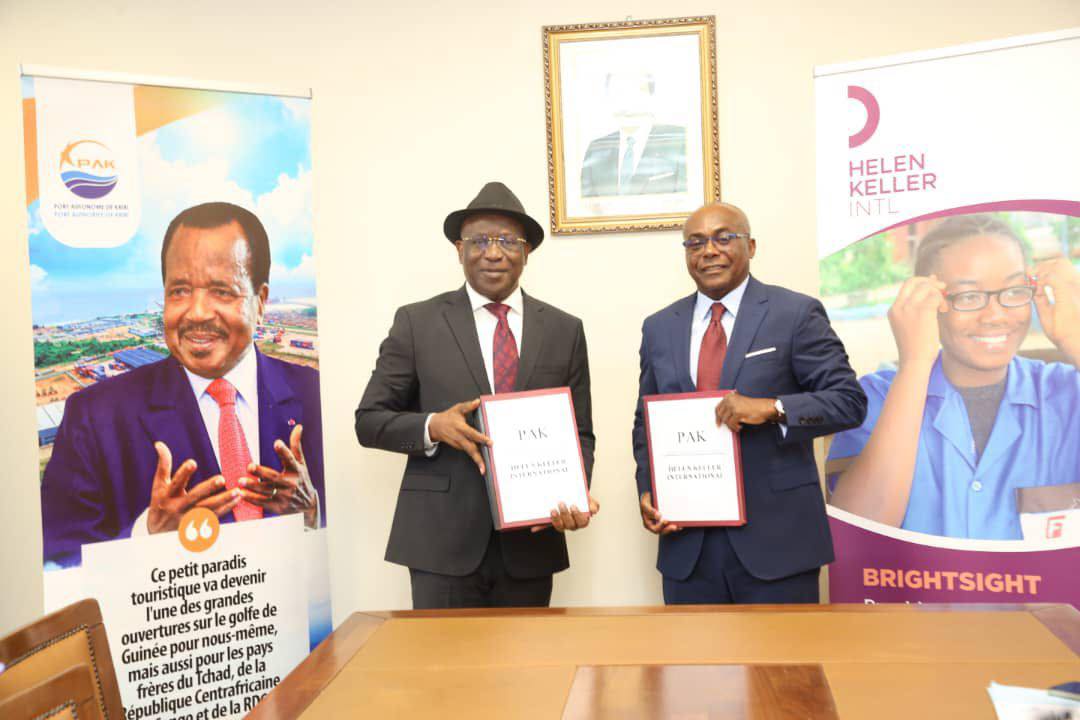
As the Port of Kribi continues to establish itself as one of Central Africa’s leading logistics hubs, its ambitions now extend beyond maritime and commercial performance. The state-owned enterprise is seeking to deepen its social footprint within neighboring communities. This commitment took shape on June 1, 2026, with the signing of a strategic partnership in Yaoundé between the Kribi Autonomous Port (PAK) and Helen Keller International (HKI), a globally recognized organization specializing in the fight against malnutrition and visual impairment.
Signed for an initial renewable period of three years, the agreement is part of PAK’s broader corporate social responsibility policy. It aims to implement community and school health programs throughout the port’s area of influence. Planned interventions will focus on preventing blindness-related diseases, reducing maternal and child malnutrition, and combating neglected tropical diseases that continue to affect several rural communities in southern Cameroon.
For the Kribi Autonomous Port, the initiative reflects a broader vision of development. The institution increasingly considers that the economic growth generated by port infrastructure must translate into tangible improvements in the living conditions of local populations. During the signing ceremony, PAK’s Director General emphasized that the partnership would complement the numerous initiatives already undertaken by the port in public health, education, water access, and community support.
The first operational project is expected to focus on eye health. Both partners are considering the signing of a specific agreement in the coming months aimed at preventing avoidable blindness and promoting eye care in schools located within the port’s sphere of influence. This is a significant challenge in a country where access to ophthalmological services remains heavily concentrated in major urban centers.
Statistics highlight the scale of the issue. According to the World Health Organization (WHO), nearly 200,000 people in Cameroon live with irreversible blindness, while more than 600,000 suffer from severe visual impairment. Cataracts, glaucoma, and eye infections remain among the leading causes of vision loss. In remote areas, shortages of specialists and limited awareness campaigns continue to hinder access to treatment and prevention services.
Helen Keller International is expected to bring globally recognized expertise to the initiative. Operating in more than twenty countries, the organization has spent decades implementing programs focused on nutrition, eye health, and community development. Its interventions have enabled millions of people, particularly across sub-Saharan Africa, to access preventive and curative healthcare services.
Beyond healthcare, the partnership also reflects the growing importance of CSR policies among major African public enterprises. For the Kribi Autonomous Port, whose investments have significantly transformed the economic landscape of southern Cameroon, the challenge now is to ensure that human development becomes a natural extension of industrial performance. Through this partnership, the port authority seeks to demonstrate that a modern port should be measured not only by cargo volumes and infrastructure capacity, but also by its ability to generate lasting social value for surrounding communities.

 La voix des entreprises
 Esther Grâce