

ROAD INFRASTRUCTURE : Bamenda Urban Crossing Reaches 34.7% Completion Despite Operational Disruptions

(LVDE) – As of May 24, 2026, in Bamenda, Cameroon’s North-West Region, the dual carriageway urban crossing project has reached a 34.7% completion rate. Despite operational disruptions and slowdowns linked to public holidays, roadworks, drainage systems and hydraulic structures continue to progress on this strategic regional corridor.
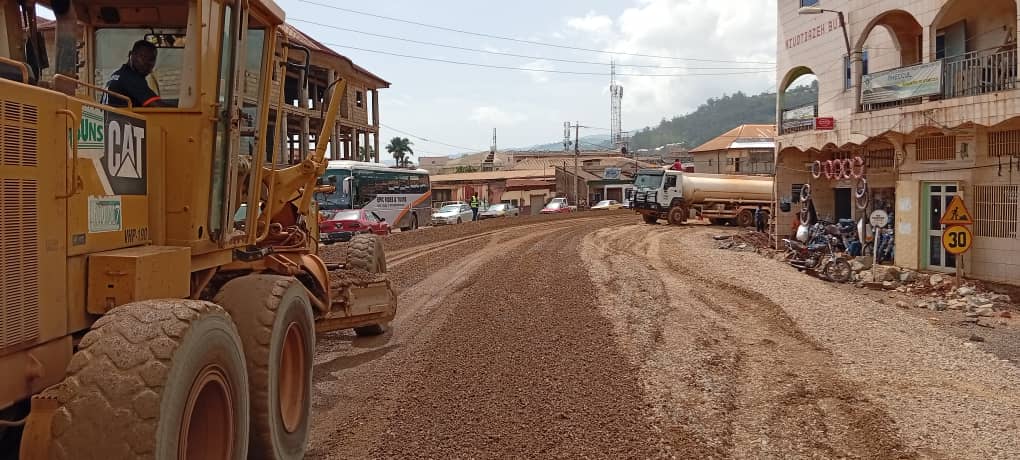
In Bamenda, the main economic hub of Cameroon’s North-West Region, the urban crossing modernization project is gradually gaining momentum. As of May 24, 2026, the project had achieved a physical execution rate of 34.7%, reflecting steady progress despite intermittent work interruptions on site.
Land clearance operations now cover nearly 6 kilometers out of the planned 6.5 kilometers, while general earthworks have reached 5.4 kilometers. This phase remains critical to transforming the urban axis into a modern dual carriageway designed to ease traffic flow and strengthen economic exchanges across the region.
On the road construction segment, pavement works are also advancing significantly. Technical teams have already completed 3.8 kilometers of subgrade layer, 3.1 kilometers of platform works and 3 kilometers of foundation layer. These operations are preparing the next paving phase, considered essential for sustainably improving urban mobility in a city facing increasing road congestion.
Drainage works are progressing simultaneously. More than 5,540 linear meters of prefabricated gutters have been produced, including 3,750 meters already installed. This component is considered strategic in a city frequently exposed to flooding and premature road deterioration during rainy seasons.
Regarding hydraulic structures, 13 out of the 20 planned facilities have already been completed, while three others remain under construction. Prefabrication of 1.5 × 1.5 meter culverts has reached 240 linear meters out of a projected 308 meters. Relocation operations involving electricity, water and telecommunications networks are meanwhile 50% completed.
Beyond its road dimension, the infrastructure represents a major economic challenge for Cameroon. The project forms part of the national strategy to modernize urban corridors and improve connectivity between regional economic zones. In a context marked by security tensions and slowing investment flows in the North-West Region, the construction site is also viewed as a signal of economic recovery and reinforced state presence.
With completion now exceeding one-third of the planned works, the project is entering a more visible phase for local populations. The main challenge will now be maintaining execution momentum in an environment still affected by climatic, logistical and security constraints.

 La voix des entreprises
 Esther Grâce