

PORTS & LOGISTICS : Kribi prepares a new expansion of its container terminal with Chinese firm CHEC

(LVDE) – Kribi Conteneurs Terminal (KCT) plans to launch a new expansion phase of its container terminal at the Kribi deep-sea port starting in July 2026. To develop an additional eight hectares of storage areas, the Cameroonian port operator is once again turning to China Harbour Engineering Company (CHEC), the Chinese firm already involved in the first two phases of the port complex. The expansion is expected to support the strong growth in maritime traffic recorded at Kribi, where nearly 750,000 TEUs were handled within a year.
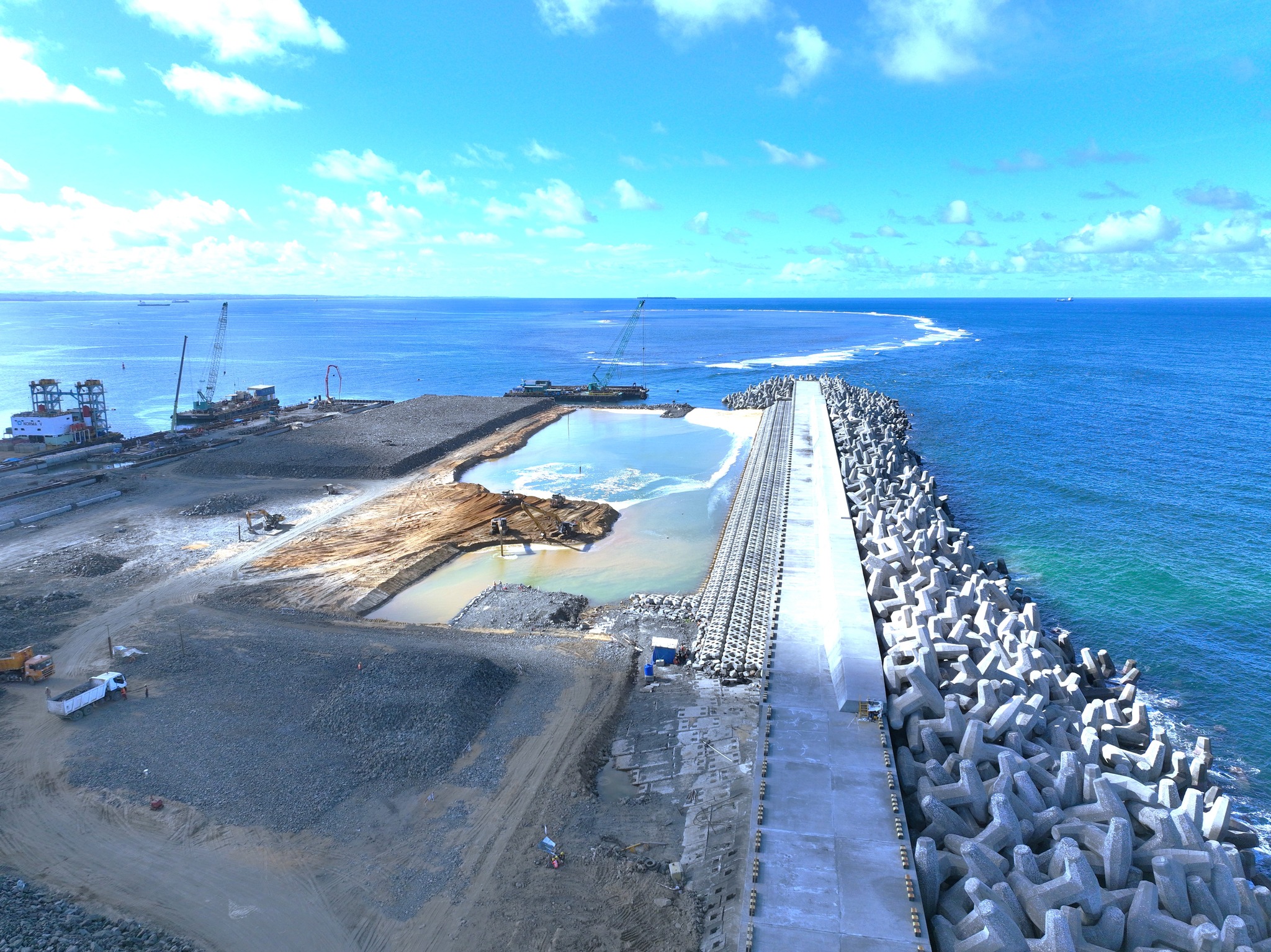
Under the humid heat of Cameroon’s coastline, the gigantic cranes of Kribi’s container terminal continue their mechanical ballet in sync with vessels arriving from Asia, Europe, and several African ports. Across the vast storage yards, containers stretch endlessly while trucks move continuously between the quays and logistics zones. In the distance, the imposing silhouettes of giant container ships reflect the steady rise of the Cameroonian port within regional maritime trade.
In this environment marked by accelerating port activity, Kribi Conteneurs Terminal (KCT) is already preparing a new development phase aimed at strengthening the platform’s logistics capacity. The operator plans to develop eight additional hectares of storage space in order to increase the terminal’s theoretical annual handling capacity from about 820,000 TEUs to nearly 1.2 million TEUs.
To carry out this new extension, KCT is once again favoring China Harbour Engineering Company (CHEC), the Chinese group that has gradually become one of Cameroon’s leading technical partners in the development of the Kribi industrial-port complex. Discussions between the two parties are already at an advanced stage, although no final agreement has yet been officially signed.
Within port industry circles, this direction is viewed as the logical continuation of a partnership that has lasted for more than fifteen years. A subsidiary of the state-owned giant China Communications Construction Company (CCCC), CHEC previously built the first phase of the Kribi deep-sea port at an estimated cost of nearly 500 million dollars. Executed under the EPC model (Engineering, Procurement and Construction), this initial project enabled the commissioning of the first container terminal, equipped with a 350-meter quay and a 16-meter-deep access channel.
As port activities continued to expand, the Cameroonian government renewed its collaboration with the Chinese group for the project’s second phase, launched in December 2019. Financed up to 85% by China Eximbank, this new phase, valued at around 793 million dollars, enabled the extension of port infrastructure through additional berths, expanded logistics areas, and the increase of the total quay length to 715 meters. The works were technically completed in February 2025.
Beyond the terminal itself, CHEC’s footprint also extends to the supporting infrastructure of the Kribi logistics corridor. The Chinese group notably participated in the construction of the Kribi-Lolabé highway designed to improve port connectivity, while a railway project linking Kribi to Édéa remains under preparation with the support of Chinese partners.
For KCT officials, relying once again on CHEC offers several technical and operational advantages. The company already has extensive knowledge of the site, the existing infrastructure, and the operational constraints of the terminal. This continuity could help shorten execution timelines while reducing construction-related risks.
This new expansion comes as Kribi’s container terminal is experiencing particularly strong growth. Within a single year, traffic increased by 82% to nearly 750,000 TEUs, mainly driven by the rise of regional transshipment activities and the regular arrival of Megamax vessels operated by major international shipping companies.
Within Central African economic and logistics circles, many observers now view Kribi as one of the most strategic port projects in the sub-region. Ultimately, Cameroonian authorities aim to transform the platform into a genuine regional hub connected to future road, rail, industrial, and mining corridors serving Cameroon, Chad, and the Central African Republic.
For now, negotiations between KCT and CHEC are still ongoing. Yet within the Kribi port complex, all indications suggest that this future expansion will represent another major step in Cameroon’s strategy to strengthen its logistics and maritime influence along Africa’s Atlantic coast.
Amélie Yandal


 La voix des entreprises
 Esther Grâce