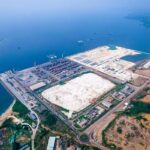
PORT OF DOUALA-BONABÉRI : PAD Confirms Transatlantic D S.A. for Cargo Scanning Despite Reservations from the Ministry of Finance

 La voix des entreprises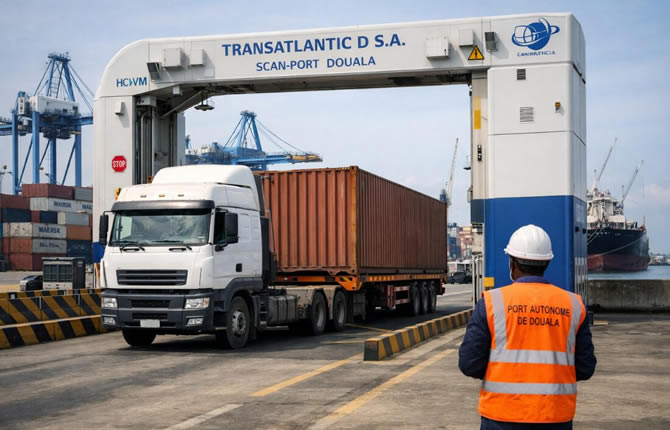
(LVDE) — Just hours before the new non-intrusive cargo inspection system comes into force, the Port Authority of Douala (PAD) is standing by its decision to appoint Transatlantic D S.A. as the exclusive cargo scanning operator. The move has sparked institutional tensions, even as the company is already deployed on the ground and ready to begin operations on January 1, 2026.
The Port of Douala-Bonabéri is on the verge of a major shift in the organization of cargo control. In a statement released on December 26, 2025, the Port Authority of Douala announced that, effective January 1, 2026, all cargo scanning operations would be carried out by Transatlantic D S.A., the concessionaire designated to perform non-intrusive inspections within the port area. The measure applies to both imports and exports and forms part of the national strategy to secure trade flows and national borders.
In practical terms, scanning fees will be paid directly to Transatlantic D S.A., headquartered at the Quifferou Building. The PAD specifies that any container for which the required fees have not been settled will be blocked within the port logistics chain, with no possibility of further processing. Ultimately, the stated objective is to achieve full traffic coverage, with systematic inspection of 100% of goods transiting through the port.
However, this orientation has not met with unanimous approval within government circles. In a letter dated December 29, 2025, the Minister of Finance, Louis Paul Motaze, urged the Managing Director of the PAD, Cyrus Ngoo, to comply with the provisions of the Scanner Inspection Contract signed on March 2, 2015, between the government and Société Générale de Surveillance (SGS). For the Ministry of Finance, this agreement remains the legal benchmark for securing customs revenue.
On the ground, however, momentum appears to be well underway. Transatlantic D S.A. has completed its operational deployment at the Port of Douala-Bonabéri, with fully functional offices within the port premises and a technological infrastructure based on next-generation scanners, supplemented by mobile inspection units deployed across several strategic sites. The system is designed to ensure fast, continuous, and fully digitized cargo inspection.
The PAD justifies its choice by pointing to the need to address shortcomings observed over the past decade. According to internal assessments, the 2015–2025 period was marked by partial traffic coverage and security vulnerabilities. The recourse to Transatlantic D S.A., under a Build-Operate-Transfer public-private partnership, is presented as a safeguard of the general interest, aligned with high-level strategic directives.
Despite institutional disagreements, the operator insists that its role remains strictly technical, focused on improving logistics flow and ensuring the secure transmission of data to the relevant authorities. Determined to honor the concession awarded to it, Transatlantic D S.A. confirms its readiness to ensure continuity of port public service from January 1, 2026, at a time when the modernization and security of the Port of Douala-Bonabéri remain critical challenges for Cameroon’s economy.
Raphael Mforlem
À propos de l'auteur








 Raphael Mforlem