

SOYBEAN SECTOR IN CAMEROON : Industrial Development Hindered by a Shortage of Raw Materials

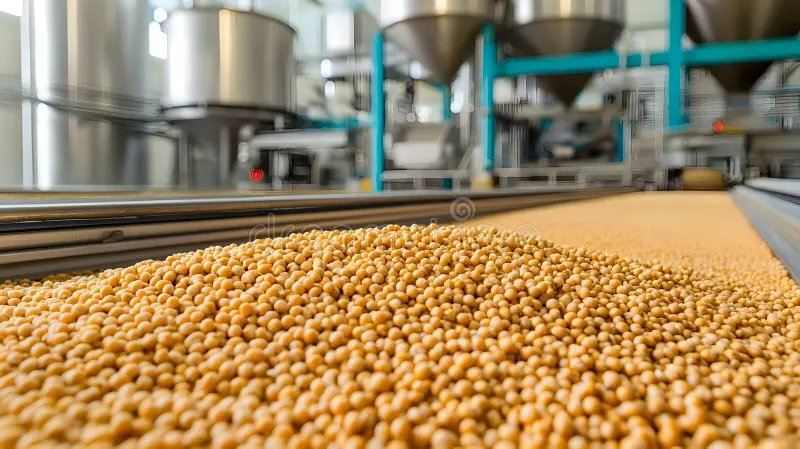
(LVDE) — In Cameroon, the industrial processing of soybeans is experiencing upward momentum, driven by several national players, but this growth is hampered by still-marginal agricultural production. The structural deficit of raw materials undermines the ambitions for self-sufficiency and reinforces a persistent dependence on imports despite ongoing projects and public financing.
The Cameroonian soybean sector highlights a significant imbalance between industrial capacity and local supply. In Douala, the Soyabeans Processing Industry of Cameroon (Soproicam SA) remains the main integrated operator in the sector. This agro-industrial company, founded in 2006 and considered the national champion of soybean processing, manages a network of over 16,000 producers in the northern regions (Adamaoua, North, Far North) to supply its processing plant in Yato, capable of handling 100 tonnes of soybeans per day. Despite this expertise, local production, projected at 50,000 tonnes in 2025, covers only a fraction of national demand. Authorities aim to double this output to 100,000 tonnes by 2030, involving up to 50,000 farmers in production zones such as Adamaoua.
Economically, Cameroon spends approximately 14 to 24.7 billion FCFA annually to import soybeans and soybean meal, reflecting a domestic market that is not satisfied by local production. Annual imports reach nearly 75,000 tonnes of soybean meal and related products, underscoring the difficulty for local processors to fully meet demand.
In this context, other agri-business companies are seeking to fill the supply gap. Agrivar Cameroon, for instance, has announced a soybean processing plant project in Douala with an investment of about 15.5 billion FCFA. The facility will have an initial capacity of 150,000 tonnes per year, expandable to 300,000 tonnes, and is expected to create nearly 1,000 jobs. The plant aims not only to produce soybean oil and meal but also to make these products more accessible to consumers and local livestock farmers.
The Cameroonian government has also provided significant support to revive the sector. In September 2025, a Murabaha financing agreement worth approximately 66.9 billion FCFA (over 119 million USD) was signed to strengthen the cotton and soybean value chains, facilitating the purchase of agricultural inputs and improving smallholders’ access to marketing mechanisms. This initiative is part of a broader strategy to boost agriculture and reduce dependence on foreign markets.
Yet despite these measures, challenges remain significant. National soybean production is still largely insufficient compared with estimated demand, and average yields — around 1.2 tonnes per hectare — remain low, though projections expect improvements (1.3 t/ha in 2025 and 1.5 t/ha in 2030). Without a radical transformation of farming practices, including better provision of inputs, improved seeds, and extension services, the growth of processing plants will continue to rely on imports or concentrated efforts in already established production zones in the North and Adamaoua.
Thus, in Cameroon, the soybean sector faces persistent tension : on one hand, industrial players like Soproicam SA and Agrivar Cameroon are expanding processing capacity, while on the other hand, agricultural production still suffers from a shortage of raw materials. This structural imbalance, if not promptly addressed, risks keeping the country dependent on imports, hindering the goal of genuine import substitution in a sector with significant potential. Raphael Mforlem

 La voix des entreprises
 Esther Grâce