

PACHIPANDA CHALLENGE 2026 : Cameroon Bets on Three Tech Projects for the International Stage

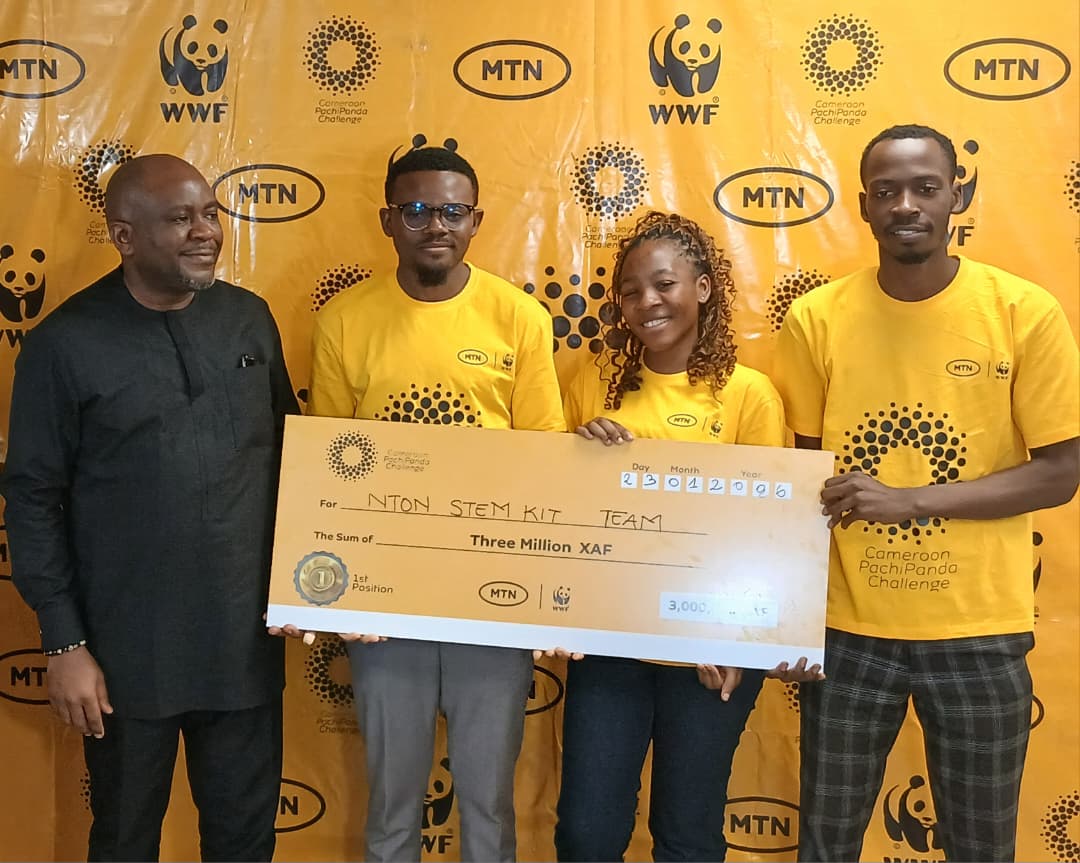
(LVDE) — In Yaoundé, the second edition of the PachiPanda Challenge has highlighted the ingenuity of Cameroonian youth in the service of the environment. Led by MTN Cameroon and WWF Cameroon, the competition rewarded three projects with strong economic and ecological potential, expected to play a role in the sustainable transformation of the local economy.
From January 9 to 23, 2026, the national phase of the PachiPanda Challenge brought together the innovation ecosystem around a shared goal : identifying practical solutions capable of combining environmental impact with economic viability. Nearly 400 applications were submitted at launch, reflecting the growing enthusiasm of young people for green entrepreneurship. After a rigorous first screening, ten finalists were shortlisted and presented their projects before a jury made up of experts, public sector representatives, and technical partners. The projects were assessed based on their relevance, feasibility, and scalability. As explained by Olivier Nyako Wadjoré, Chair of the Jury, “it was essential to ensure that each initiative addressed a real need while being built on a solid business model.”
The first prize, worth CFA 3 million, went to nTron STEM Kit. The project stands out for its original approach combining plastic waste recycling, local manufacturing, and science and technology education. By transforming used plastic into filament for 3D printers, the team produces educational kits that allow students to experiment with electronics, robotics, and renewable energy systems. This approach helps reduce pollution while developing technical skills among young people. The business model is based on cost-controlled local production and a customer base made up of schools and educational institutions, although challenges remain in terms of scaling up industrial production.
Ranked second and awarded CFA 2 million, the startup FurahaTalla offers a digital response to the difficulties faced by farmers due to climate uncertainty. Its platform, accessible via basic mobile phones or a mobile app, allows producers to sell their future harvests in advance at a secured price. An intelligent system analyzes climate data and market trends to set fair pricing. Buyers commit through contracts and pay an advance, providing farmers with much-needed cash flow at the beginning of the farming season. In a context where post-harvest losses and distress sales weaken rural incomes, the solution appears to be a powerful lever for economic stabilization.
The third prize, worth CFA 1.5 million, was awarded to AgriCheck, a smart agriculture platform that facilitates access to farm inputs without immediate payment. By leveraging satellite, climate, and agronomic data, the tool assesses risk at the level of each farm and adapts support mechanisms accordingly. This approach reduces uncertainty for financial partners and improves yield prospects for smallholder farmers.
For MTN Cameroon, the stakes go beyond the financial reward. “Above all, the candidates benefited from mentoring and training aimed at structuring their projects,” emphasized Edouard Tamba, noting that the winners will represent Cameroon at the pan-African final in Johannesburg. WWF Cameroon, for its part, stresses the environmental significance of these initiatives. “What matters is the ability of these young people to turn their ideas into concrete actions for the benefit of communities and nature,” said a representative of the organization.
At the end of this 2026 edition, the three winning projects embody complementary pathways toward a greener economy : recycling and technological education, climate-resilient agriculture, and digital innovation in support of producers. Their future will now depend on their ability to attract partners, mobilize funding, and anchor themselves sustainably within Cameroon’s economic fabric.
Raphael Mforlem

 Esther Grâce
 La voix des entreprises