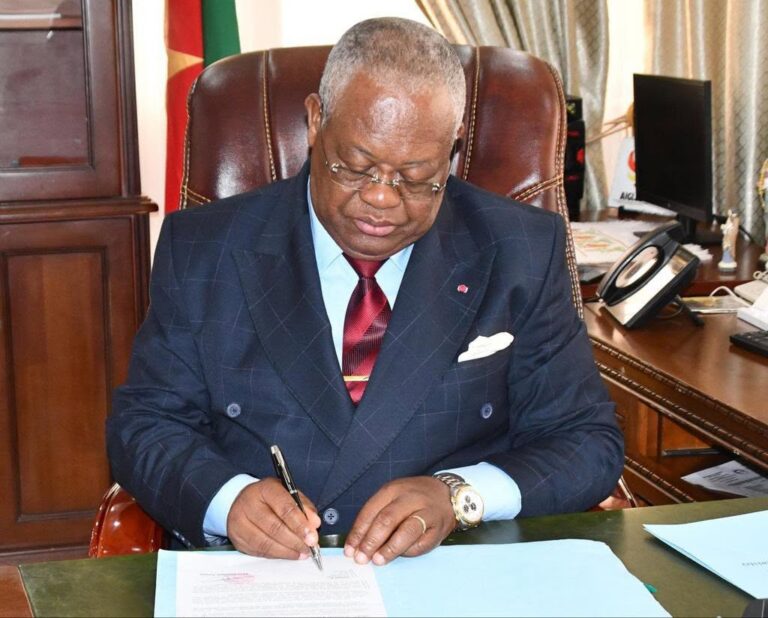


Serge Hervé Boyogueno, CEO of SONAMINES : “Taxation and administrative delays fuel the illegal export of gold in Cameroon”


Serge Hervé Boyogueno, CEO of SONAMINES
(Source : ecomatin.net)
The revelation of a striking gap between the volumes of gold officially exported by Cameroon and those recorded abroad has reignited debate over gold smuggling and the effectiveness of State control mechanisms. The 2023 EITI Report indicates that more than 15 tonnes of Cameroonian gold were received in the United Arab Emirates, compared with only a few kilograms declared by national customs, fueling persistent public controversy. In response to these recurring questions, the Chief Executive Officer of the National Mining Corporation (SONAMINES), the State’s operational arm in the mining sector, breaks his silence. In this exclusive interview with EcoMatin, Serge Hervé Boyogueno provides clarifications and outlines his institution’s perspective.
Mr. Chief Executive Officer, the 2023 EITI report reveals an abyssal gap : 15.2 tonnes of Cameroonian gold received in the Emirates versus only 22 kg recorded by our customs services. How does SONAMINES, which represents the interests of the Cameroonian State in the mining sector, explain that a volume worth nearly CFA 560 billion could leave the country without leaving any major administrative trace ?
Allow me to state from the outset that the National Mining Corporation (SONAMINES S.A.) was entrusted with the mission of controlling and monitoring the production, marketing, processing and valorization of precious and semi-precious substances derived from artisanal and semi-mechanized artisanal mining, pursuant to the provisions of Article 116 of the Mining Code Law of December 19, 2023—just days before the end of the EITI reporting year under review. The implementing decrees clarifying the roles of the various stakeholders were issued a year later, on November 18 and 19, 2024.
“The discrepancies reflected in the figures reported in the EITI report are not new.”
That said, it is important to stress that the discrepancies highlighted in the aforementioned EITI report are not new. Indeed, in its analysis report published in May 2021 on “Illegal gold mining in Central Africa,” INTERPOL had already noted that over a ten-year period (2008–2018), long before the creation of SONAMINES, gold imports by the United Arab Emirates from Cameroon rose from 0.3 to 11.7 tonnes, while over the same period, Cameroon’s officially declared annual exports to the UAE never exceeded 32 kilograms. By way of illustration : exports from Cameroon were about 10.9 tonnes in 2017 versus 29.7 kg officially exported; 9.94 tonnes in 2016 versus 2.35 kg officially exported; 10.43 tonnes in 2015 versus 87 kg officially exported; 8.67 tonnes in 2014 versus 248 kg officially exported; and 9.57 tonnes in 2013 versus 122 kg officially exported.
To return to your question, I would like to emphasize that SONAMINES is indeed present at all semi-mechanized artisanal mining sites that it has previously identified. Most of these mining activities are illegal, as they are carried out without authorization and in blatant violation of the law. Proof of this is provided by the report of the joint MINMIDT–MINEPDED–SONAMINES mission conducted from October 20 to 26, 2025, in the East and Adamawa regions, which showed that 94 out of 101 sites visited (operational or inactive) were operating without a semi-mechanized artisanal mining permit. These activities are also conducted without a summary study validated by MINMIDT specifying, among other things, the surface area, quantities and thickness of the ore to be exploited—preventing the State from anticipating or forecasting returns from these operations.
Through its presence on all identified semi-mechanized artisanal mining sites, and despite the declarative system used to determine the tax base for in-kind levies, SONAMINES monitors production 24/7 and collects the Lump-Sum Mining Tax (ISML) as well as the exit duty, for a combined rate of 28.75% of total production. In the absence of channeling funds to purchase the remaining production for the establishment of the State’s strategic gold reserves, operators are free to dispose of the remainder of their production, which is nonetheless traced at SONAMINES local offices. The issue, therefore, is not administrative traceability, but rather the export of this portion, which involves several other institutional actors.
Why, despite reforms initiated since 2024, does artisanal gold leakage remain massive in Cameroon, and what levers does SONAMINES consider a priority to put an end to it ?
Strictly artisanal mining, which generates the bulk of Cameroon’s gold production, is currently being structured by SONAMINES pursuant to the decree of November 19, 2024, governing the possession, marketing, export, import and transit of mineral substances. This includes formalizing artisans into cooperatives; continuous monitoring of collectors—who are the artisans’ main clients and whose operating licenses are issued by SONAMINES, to which they sell exclusively; and a draft partnership agreement with mining municipalities in the East to support sustainable development of artisanal mining.
“Strictly artisanal mining, which generates the bulk of Cameroon’s gold production, is currently being structured by SONAMINES.”
It should also be emphasized that Cameroon is a hub for gold and diamond trade originating from the sub-region. Consequently, the figures published in Dubai are not exclusively derived from gold produced in Cameroon’s subsoil.
In any event, strong actions remain necessary to effectively combat the massive leakage of gold produced and transiting through Cameroon, notably: allocating funds to SONAMINES to purchase the entire national gold production for the establishment of the State’s strategic gold reserves; the immediate closure of all illegal semi-mechanized artisanal mining sites pending compliance; strict enforcement of the Mining Code provisions requiring gold to be exported in refined form and stamped by SONAMINES—given that to date only two 2-kg gold bars have been stamped; better harmonization of actions among institutional actors involved in mineral export operations, for which we have sought government coordination; and the streamlining of export procedures which, along with excessive taxation, are the main drivers of exporter flight. For instance, since April 30, 2024, we have been awaiting an authenticity certificate for two gold bars—one of the documents required for export authorization.
SONAMINES was created with the ambition of channeling gold from artisanal mining. Yet UN “mirror data” (Comtrade) show that informality tripled between 2022 and 2023. Is your current collection mechanism structurally ill-suited to non-approved trading networks dominating the field ?
SONAMINES’ primary mission under its founding decree is to develop and promote the mining sector in Cameroon (excluding hydrocarbons and quarry substances) and to manage the State’s interests therein. Gold channeling—understood as the active migration of gold from the informal to the State’s official circuit through purchases from producers to strengthen strategic reserves—was previously carried out by the former CAPAM, which benefited from initial funding (HIPC, MDRI and State budget) to supervise artisans and purchase their entire production.
Three months after taking office in July 2021, we developed, with experts, a “gold channeling strategy” and subsequently a “gold purchase and marketing strategy,” validated by our governing bodies and continuously refined through benchmarking. This led to the strategic gold reserve project, already approved at the highest level, with ongoing work with the Ministry of Finance to mobilize the necessary funds.
The November 19, 2024 decree enabled SONAMINES to finalize its control, monitoring, channeling and tax collection mechanisms. We have since issued 383 collector cards to Cameroonian nationals who buy from artisans and sell exclusively to SONAMINES, while formalizing artisans into cooperatives. On semi-mechanized sites, our staff monitor production day and night, allowing us to collect nearly 1,000 kg of gold for the State since July 16, 2021—compared with about 777 kg collected by the former CAPAM over more than 15 years.
Our mechanism is therefore effective ; the main constraint is the lack of funds to purchase gold for the State. We have thus refrained from licensing private trading counters, prioritizing the constitution of strategic reserves, especially given the existence of about 150 valid buying and trading offices previously licensed by the Ministry in charge of mines.
“Illegal export of Cameroonian gold is fueled by weak involvement of other institutional actors, porous borders, excessive taxation relative to the sub-region, and administrative delays.”
Export issues fall outside SONAMINES’ remit and involve multiple institutions, hence our request for Prime Ministerial coordination. Illicit exports are driven by porous borders, excessive taxation—over 10% in Cameroon versus 3% in Chad—and administrative delays.
The 2023 EITI report notes a net loss of CFA 1.82 billion for SONAMINES despite increased gold collections, citing a regulatory vacuum around the ISML. What explains this deficit ?
As you rightly note, the regulatory vacuum surrounding the ISML explains this so-called net loss. After CAPAM ceased operations in June 2021, SONAMINES resumed ISML collection on July 16, 2021, without a formal mandate or financing, using part of its capital. In the absence of a text governing ISML allocation, collected resources could not be booked as operating revenue, despite substantial investments, creating a temporary accounting deficit.
This situation evolved with Ministerial Order No. 00000017/MINFI of July 16, 2025, which set allocation rules. In October 2025, the Ministry of Finance recorded gold stocks collected between July 2021–December 2022 and August 2024–April 2025. Once funds are disbursed, SONAMINES’ accounts will reflect its true performance, and the 2023 deficit will be absorbed.
Do you advocate tax relief to encourage formal declaration, or is the issue more about enforcement and border control ?
Cameroon’s gold sector faces excessive taxation—often termed hyper-taxation—driving actors to bypass formal channels. For semi-mechanized artisanal mining, the State currently levies 28.75% in kind, plus 19.25% VAT and export-related costs. Meaningful tax reform on raw gold is key to formalization and revenue growth. Repression alone is insufficient; despite seizures since 2022, smuggling persists, underscoring the need to simplify export procedures.
Beyond gold, diamonds are subject to the Kimberley Process. Given porous flows for gold, what guarantees exist for diamond traceability in the East ?
Diamond traceability, certification and export are governed by the Kimberley Process, which Cameroon joined in 2012. The system, equipped with an Evaluation and Diamond Expertise Bureau and airport/site staff, is best positioned to address these concerns.
Source : ecomatin.net

 La voix des entreprises
 Esther Grâce