

GABON : Todini revives the Booué and Tsengué-Lélédi hydropower dam projects

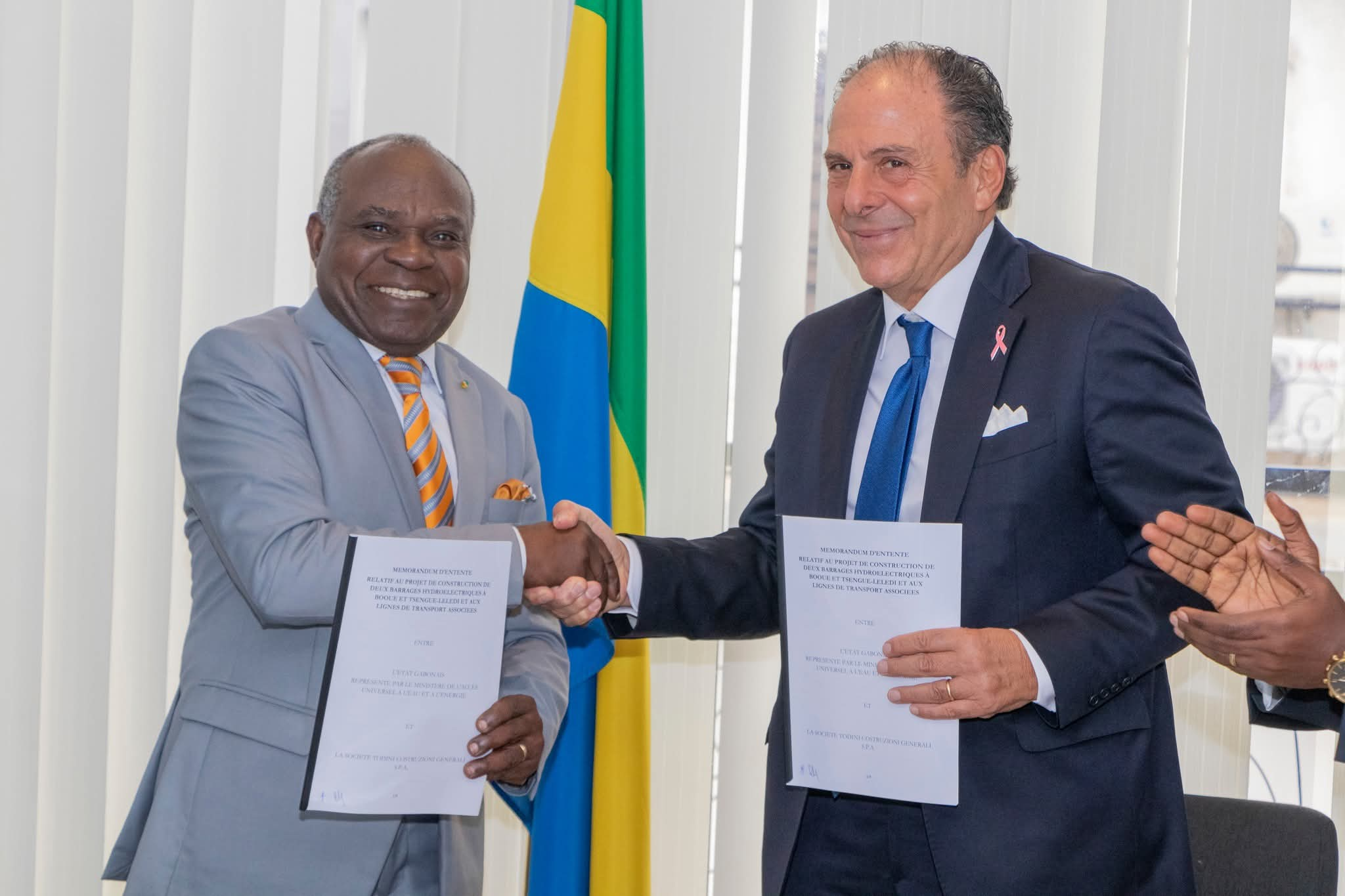
(LVDE) – The signing of a memorandum of understanding between the Minister of Universal Access to Water and Energy and the Italian company took place on September 16. These dams aim to boost national electricity production and promote regional integration.
Gabon, endowed with abundant water resources, is firmly committing to a new energy era. On September 16, 2025, the Minister of Universal Access to Water and Energy, Philippe Tonangoye, formalized a memorandum of understanding (MoU) with Todini Costruzioni Generali S.p.A., an Italian company renowned for its expertise in hydraulic infrastructure. This agreement marks a significant step toward the construction of the Booué and Tsengué-Lélédi dams—two key projects for the country’s energy development.
Once operational, these infrastructures are expected not only to secure Gabon’s power supply but also to diversify its energy mix, which is currently dominated by thermal power plants. The project addresses an urgent need, as the country faces rising electricity demand often accompanied by frequent power outages. With the addition of these dams, Gabonese authorities aim to stabilize electricity supply while supporting the economic growth of the Moyen-Ogooué and Ogooué-Ivindo regions.
Beyond national benefits, Libreville is pursuing an ambitious regional vision. Authorities are considering an electrical interconnection with neighboring countries, including Congo, Cameroon, and Equatorial Guinea. This initiative seeks to harness Gabon’s largely untapped waterfalls and integrate the country into the Central African energy market. In this regard, self-sufficiency and regional complementarity have become crucial to sustainable energy development within the subregion.
However, this initiative is not entirely new. In 2019, preliminary studies funded by the African Development Bank (AfDB) had already been launched to explore cross-border electrification and rural supply possibilities. Unfortunately, in the absence of tangible progress and official communication, these projects were suspended until their recent revival by the transitional government.
Faced with the Société d’Énergie et d’Eau du Gabon (SEEG)’s ongoing difficulties in meeting ever-increasing demand, authorities have incorporated the revival of the Booué and Tsengué-Lélédi dam projects into the National Development Plan for the Transition (PNDT). This strategic plan outlines substantial investments to modernize the national grid and promote renewable energy. Between 2024 and 2026, Gabon plans to invest 1,134.5 billion CFA francs—roughly 378 billion per year—to finance new electricity projects.
This momentum comes as Gabon seeks to establish itself as a key player in the regional energy sector. By reviving these hydropower projects, the country aims to reshape its energy landscape while contributing to environmental sustainability. Todini’s involvement in this endeavor offers Gabon access to advanced technology and proven expertise, further strengthening its capacity to tackle the energy challenges of tomorrow. Sorelle Ninguem

 Sorelle NINGOUEM