

ACCESS TO DECENT HOUSING : Shelter Afrique Development Bank Invests CFAF 16 Billion in the Central African Republic
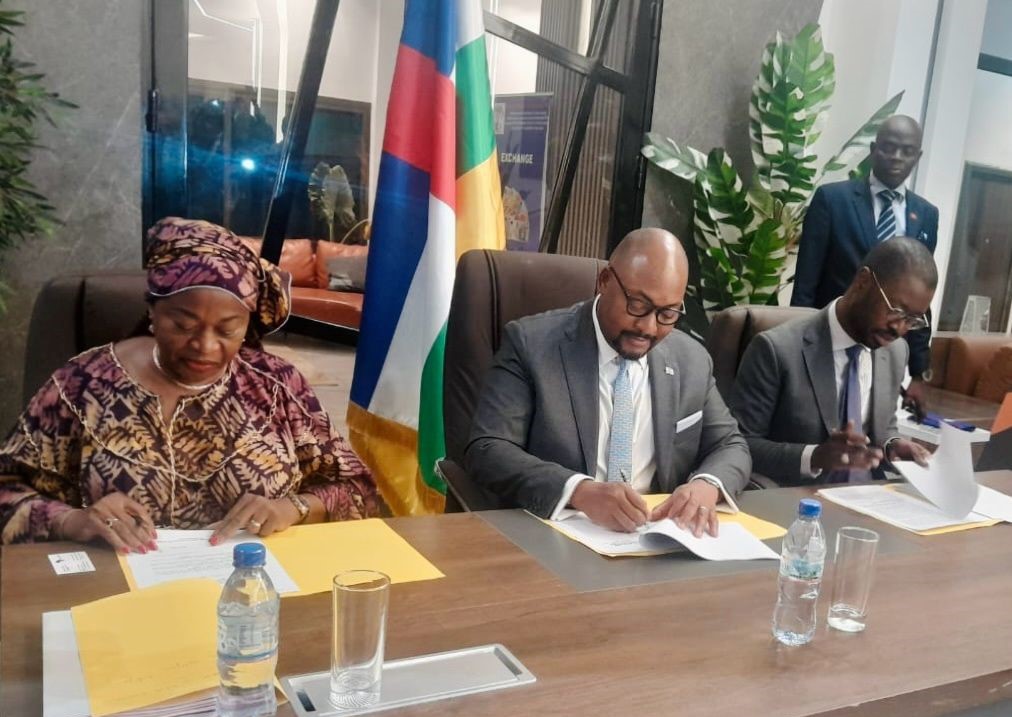
(LVDE) – At the 2025 Annual African Caucus Meeting, the Central African Republic formalized two major agreements, including one with Shelter Afrique Development Bank (ShafDB) to construct social housing. This crucial investment aims to address the country’s urgent housing needs.
On July 31, 2025, the Central African Republic reached a significant milestone in its quest to improve living conditions for its population. On the sidelines of the Annual African Caucus Meeting — hosted for the first time in the country — the Bangui government signed an ambitious agreement with Shelter Afrique Development Bank (ShafDB), a multinational development institution. This commitment represents a $28 million investment (approximately CFAF 16 billion) to build 300 social housing units. The agreement was signed by Thierno-Habib Hann, Director General of ShafDB, alongside the Central African ministers of Finance and Housing.
The project will begin with a pilot phase in Bossangoa and is designed to address the acute shortage of housing in a nation where political and security crises have severely impacted living standards. According to 2015 estimates, the Central African Republic was short nearly one million housing units, a figure that has not been updated since. As a result, about 15% of the population has limited access to decent housing. While the country’s housing deficit is lower than Cameroon’s, it remains concerning compared to neighboring countries such as Gabon and Congo-Brazzaville.
Finance Minister Hervé Ndoba emphasized the importance of the initiative, calling it a real driver of growth. “When we talk about social housing, we are talking about an economic lever. It will impact employment, consumption, and contribute to the development of human capital,” he stated. His remarks highlight how crucial access to decent housing is for the country’s socio-economic development.
Through its various initiatives across the CEMAC region, ShafDB has proven its commitment to reducing the housing deficit. For example, the bank recently completed 135 social housing units in Chad for $18 million and announced similar investments in Cameroon. As part of its portfolio, it has also signed a project for 3,000 housing units in the Republic of Congo, underscoring its central role in promoting housing in Central Africa.
In addition, the Central African government signed a second agreement to relaunch the Boali-3 hydroelectric dam project, with a planned capacity of 10 MW. Stalled since 2013 due to the country’s instability, the project is expected to receive $30 million in financing, along with a $20 million pledge from the American investment fund Neo Themis. The Finance Minister highlighted the importance of the dam for strengthening the Central African Republic’s energy potential, which is essential to its development.
These agreements represent significant progress for the country and could serve as catalysts for attracting further foreign investment needed to revive the economy. As the Central African Republic continues to face numerous challenges, these initiatives may well mark a new beginning toward building a more stable and prosperous future for its people.
Esther Grace

 Tressy CHOUENTE
 La voix des entreprises