PORT OF DOUALA-BONABÉRI : PAD bets on Douala Port Railway Investment Company to modernize port rail network
(LVDE) – The Port Autonome de Douala (PAD) signed a concession agreement on March 19, 2026 with Douala Port Railway Investment Company (DPRIC) to modernize and expand the port’s railway network. This public-private partnership, worth CFA 40 billion, aims to enhance the port’s competitiveness while improving urban mobility.
 La voix des entreprises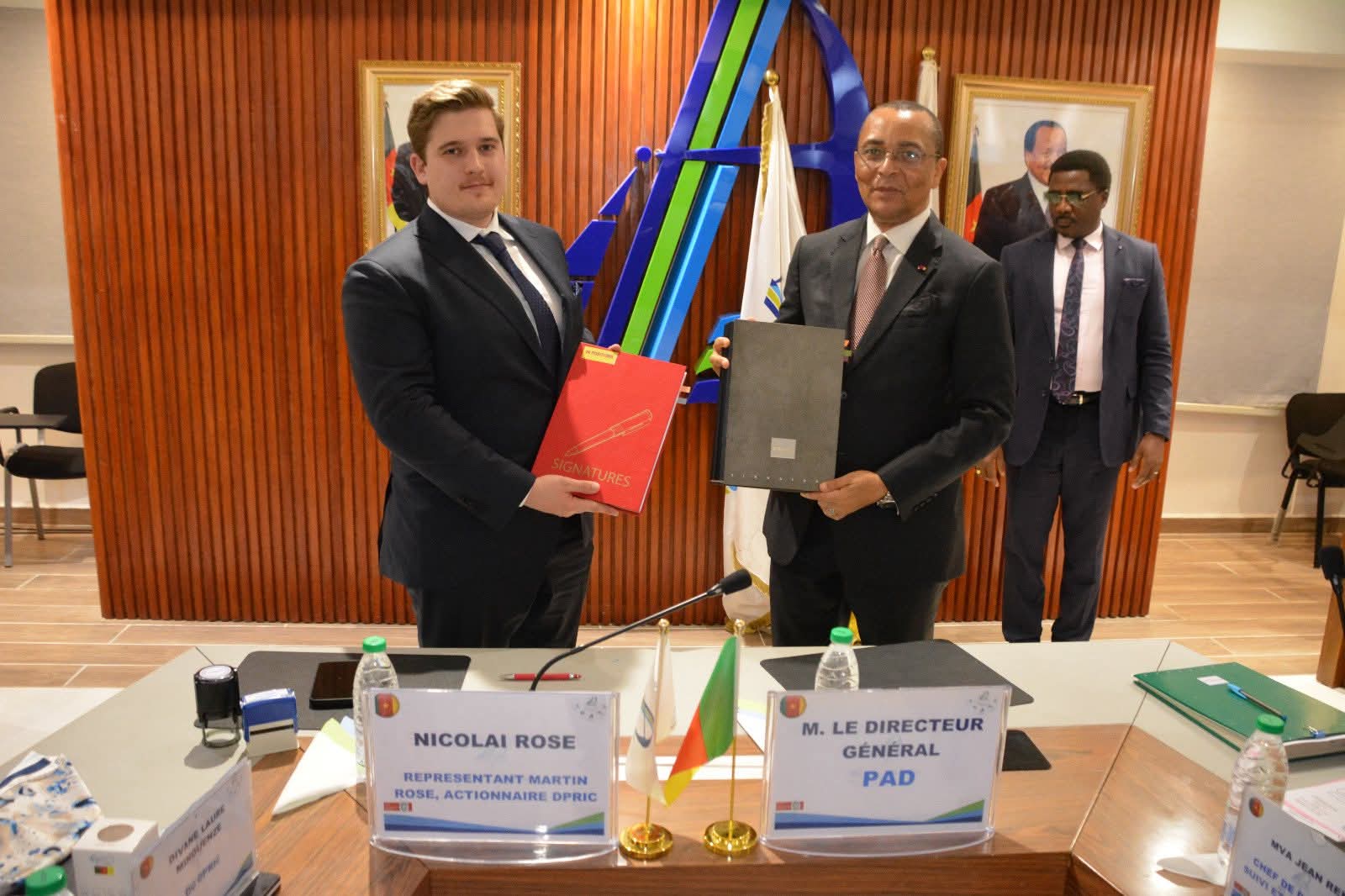
Exchange of folders between Cyrus NGO’O, CEO of the Port Autonome de Douala, and Nicolai Rose, representative of Douala Port Railway Investment Company.
This marks a new milestone in the modernization drive of the Port Autonome de Douala. Its Director General, Cyrus NGO’O, alongside Nicolai Rose, formalized the agreement, which focuses on upgrading and extending the railway network within the Douala-Bonabéri port area—an essential corridor for Cameroon’s logistics development.
Structured under a Design-Build-Finance-Maintain (DBFM) model, the partnership involves full financing by the private partner over a 25-year period. It covers all phases of the project, from design and construction to operation and maintenance, before the infrastructure is transferred back to the PAD. The objective is to equip the port with a modern, efficient rail system incorporating advanced technologies.
The expected benefits are wide-ranging. Economically, the project is set to create around 120 direct jobs and 360 indirect jobs, with priority given to local expertise. It will also support training and professional integration for young Cameroonian graduates through a joint program implemented by both partners.
Beyond the economic impact, upgrading rail transport is expected to improve urban living conditions by reducing road congestion caused by heavy trucks, lowering traffic accidents, and cutting air and noise pollution.
From a financial standpoint, the PAD will receive a fixed annual fee as well as a progressive share of the concessionaire’s revenue: 5% during the first ten years, 7% from the eleventh to the twentieth year, and 8% from the twenty-first to the twenty-fifth year. Overall, projected revenues are estimated at over CFA 8.5 billion, excluding taxes, over the duration of the project.
Included in the 2020–2050 Master Plan, this initiative forms part of a broader strategy to rehabilitate and modernize infrastructure at the Port of Douala-Bonabéri. It is expected to strengthen the performance, attractiveness, and competitiveness of this major port platform, while consolidating its position as a leading logistics hub in the Gulf of Guinea.
Esther Grace
À propos de l'auteur






 Esther Grâce
 Raphael Mforlem