KRIBI REFINERY : CSTAR seeks to bring forward partial start-up in the second half of 2026

 La voix des entreprises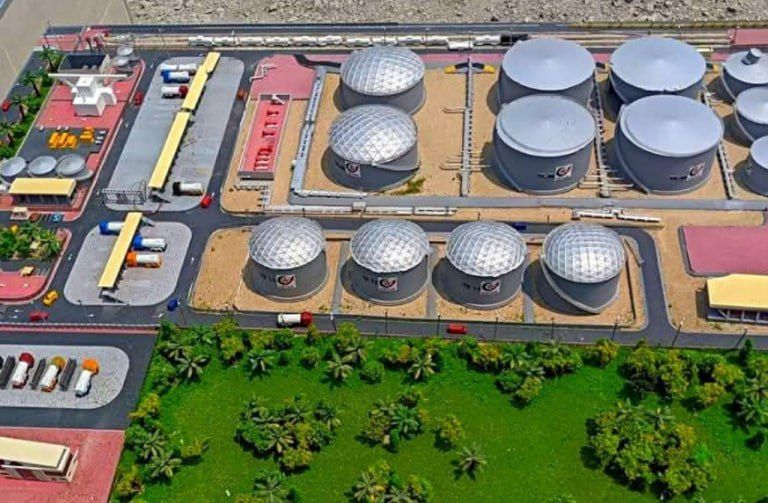
(LVDE) — As construction of the Kribi refinery enters a decisive phase, Cstar Petroleum is considering an early commissioning scenario. Project promoters are targeting partial production of 10,000 barrels per day in the second half of 2026, a prospect that rekindles hopes of a rapid reduction in the country’s dependence on fuel imports.
At the Kribi port site, activity around the refinery project remains intense. Behind the scenes, shareholders of Cstar Petroleum—the project company backed by SNH, Tradex and Ariana Energy—are refining their timeline. According to information presented to the Board of Directors in December 2025, an “early production” plan предусматриes a partial start-up as early as the second half of 2026, with an initial capacity estimated at 10,000 barrels per day. This gradual ramp-up would represent about one third of the projected final capacity of 30,000 barrels per day.
For the project promoters, this first phase of operation would already cover nearly 22% of national fuel demand, particularly for diesel and gasoline. This would be a significant step forward in a context marked by heavy reliance on imports and the still-felt consequences of the shutdown of Sonara. If this scenario materializes, it would also represent a notable acceleration compared with the initial timetable, which had scheduled full commissioning around June 2028.
The Kribi petroleum complex project was officially launched on July 17, 2025 on a site covering approximately 250 hectares. It combines an industrial refinery and a petroleum products storage terminal. According to data released by Cstar, storage capacity is expected to reach 250,000 m³ initially, with a possible extension to 300,000 m³. Total investment is currently estimated at around CFAF 115 billion, subject to the finalization of technical studies. Construction has been entrusted to an international consortium comprising RCG Turnkey Solutions, Global Process Systems and Norinco International, while BGFI Cameroon is leading the financial structuring with a target envelope of CFAF 120 billion.
Beyond the infrastructure itself, the overall balance of the national energy market is at stake. Annual demand for petroleum products is estimated at around 1.9 million tonnes, while current storage capacities remain below the standards recommended to ensure supply security. Projections put forward by the project developers point to a reduction in imports of about 30%, annual savings close to CFAF 400 billion, and additional export revenues, notably in the marine fuels segment. Added to this are significant social benefits, with several thousand direct and indirect jobs announced.
Structured around two separate entities—Cstar Tank Farm for the terminal and Cstar Refinery for the processing unit—the project is intended to be a pillar of Cameroon’s energy sovereignty strategy. In the long term, and with the integration of units dedicated to biofuels, its promoters estimate that the complex could cover up to 70% of local market needs. An ambition that now places the Kribi refinery at the heart of the country’s economic and industrial expectations.
Raphael Mforlem
À propos de l'auteur







 Raphael Mforlem