TRADE : Cameroon and China Ratify a Framework Agreement to Boost Exports and Strengthen Business Competitiveness

 La voix des entreprises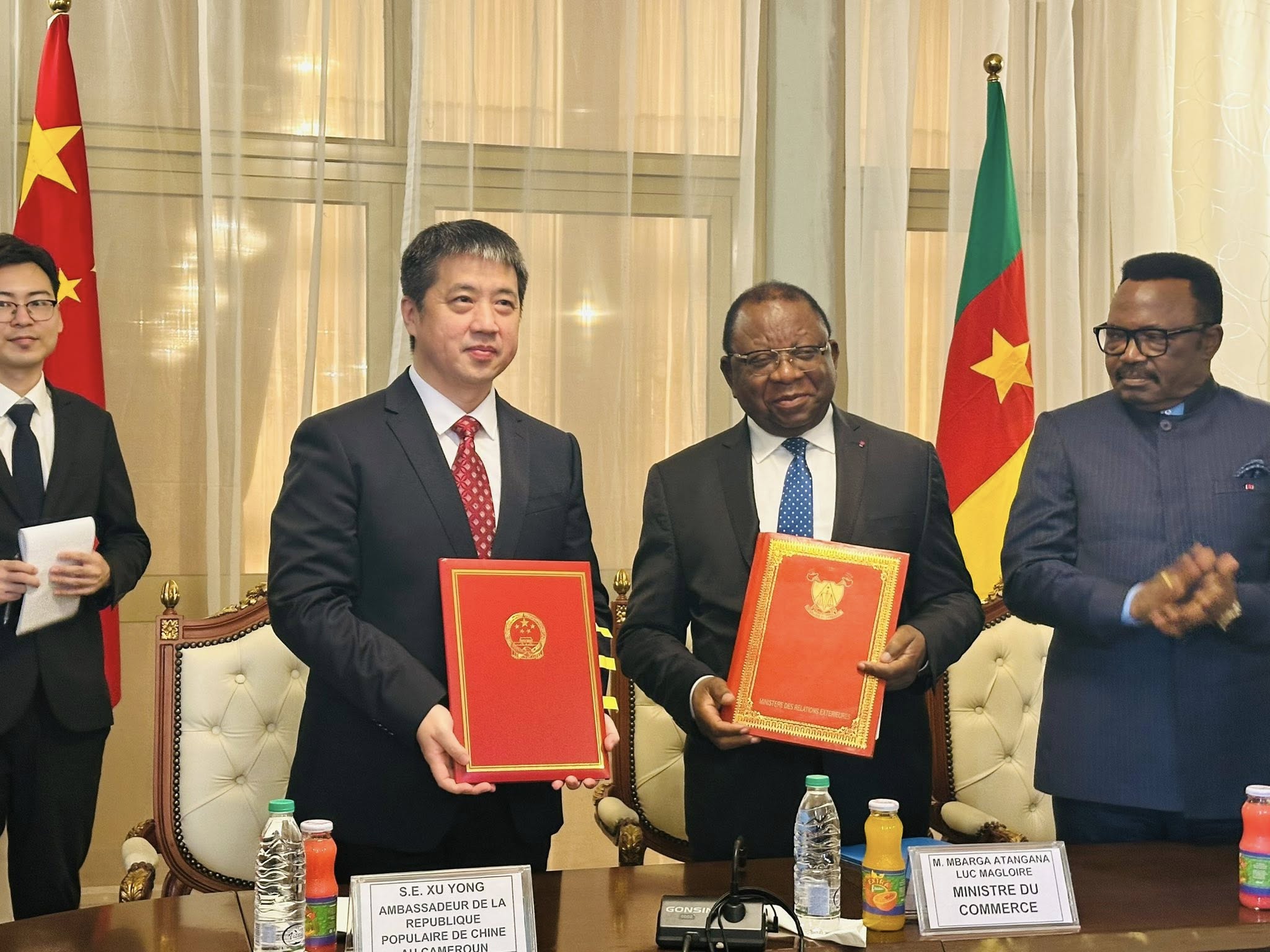
(LVDE) — This document, signed on December 10, 2025, by the Minister of Trade, Luc Magloire Mbarga Atangana, and Ambassador Xu Yong, aims to improve access to the Chinese market, promote industrialization, and modernize supply chains.
A climate of hope filled the Ceremonial Hall of the Ministry of External Relations, where Cameroon and China took a decisive step forward in their economic cooperation. The Minister of Trade, Luc Magloire Mbarga Atangana, sealed the framework agreement with Ambassador Xu Yong amid camera flashes. The moment symbolized a new era in an already well-established partnership. Precisely at 11:00 a.m., the signatures marked the opening of a promising new chapter for both nations.
At the heart of the agreement lies the ambition to strengthen trade relations between Yaoundé and Beijing. The Minister of Trade emphasized the importance of earlier discussions between President Paul Biya and Chinese President Xi Jinping. These meetings, driven by a shared determination to anchor cooperation within a strategic framework, fall under the Forum on China–Africa Cooperation (FOCAC), a key platform for economic and technological relations between China and the African continent.
The figures speak for themselves : in 2024, Cameroon recorded trade flows exceeding CFA 1.6 trillion with China, including CFA 1.1 trillion in imports and CFA 500 billion in exports. As Cameroon’s leading supplier and foreign investor, China supports several strategic sectors, including construction and public works, energy, agriculture, and telecommunications. Luc Magloire Mbarga Atangana stated that the Chinese market—estimated at 1.41 billion consumers—represents a “historic opportunity” for Cameroonian exporters seeking to diversify their markets.
The signed agreement paves the way for a series of negotiations structured around four main pillars : trade facilitation, integration into production chains, securing supply chains, and the adoption of innovative business models. The objective is clear: to provide broader access for Cameroonian products to the Chinese market, ideally on a duty-free basis. This momentum could significantly enhance the competitiveness of Cameroon’s agricultural and industrial value chains, particularly those pursuing higher value-added production.
Aligned with Vision 2035, the agreement represents a key strategy for the structural transformation of Cameroon’s economy. Experts from both countries are now tasked with refining the technical modalities required to implement this ambitious roadmap set out by their leaders. As the delegations took their leave, the atmosphere remained one of optimism—a partnership aspiring to reach new heights and project Cameroon into global value chains.
This renewed diplomatic and economic momentum opens the door to numerous opportunities for Cameroon, which hopes to leverage its partnership with one of the world’s most dynamic economies. The countdown has begun to turn this vision into reality, with the goal of successfully integrating Cameroon into the global economic ecosystem.
Esther Grâce
À propos de l'auteur








 Raphael Mforlem