DOUALA PORT AUTHORITY : Export–Import traffic increases by 6% in 2024

 La voix des entreprises
Douala Port Authority
(LVDE) – This figure, which reflects the significant growth in traffic at the Port of Douala-Bonabéri, was revealed during the Board of Directors meeting of the National Ports Authority (NPA), held last September in Yaoundé.
On September 25, 2025, in Yaoundé, the Board of Directors of the National Ports Authority (NPA) met to review the annual report on the state of the port sector in Cameroon. The results presented highlighted a mixed situation : while overall traffic recorded a slight decline, significant progress was observed in infrastructure development and operational efficiency.
According to data provided by Ayuketah Pamela, Acting Director General of the NPA, the total volume of goods handled in Cameroonian ports decreased by 1%, dropping from 27.15 million tonnes in 2023 to 26.93 million tonnes in 2024. Although concerning, this decrease remains modest in an international context marked by slowing global trade and rising logistics costs, according to the website investiraucameroun.com.
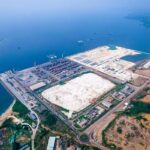
Nevertheless, the Port of Douala, the country’s main maritime hub, posted distinctly positive results. Its export–import traffic grew by 6%, reaching 12.92 million tonnes in 2024, compared with 12.19 million tonnes the previous year—an increase of 723,425 tonnes. This strong performance reinforces Douala’s position as Cameroon’s leading port and strengthens its status as a strategic platform for subregional trade.
In contrast, the Port of Kribi recorded stable figures, maintaining traffic at 10.84 million tonnes, while Limbe experienced a sharp 23% drop, equivalent to a decrease of 957,162 tonnes in one year. This imbalance underscores the need for targeted initiatives to revive the Limbe port.
The NPA report also highlights ongoing efforts to modernize port infrastructure. In Douala, construction and rehabilitation works have been intensified to enhance competitiveness and streamline operations. Meanwhile, the deep seaport project in Ngeme, Limbe, remains in the preparatory phase, with feasibility studies currently being updated. These major projects aim not only to strengthen Cameroon’s maritime capacity but also to improve national access routes, which are essential for economic development.
On the security front, robust measures have been implemented, including a project to secure the public port domain of Douala and the training of security personnel. Additionally, the Port of Kribi renewed its ISPS Code compliance certificate, ensuring adherence to international maritime security standards.
The Board also commended the efforts devoted to promoting the Port of Kribi and the investments made in Douala. These actions have been crucial in improving the country’s overall logistics performance and increasing the competitiveness of Cameroonian ports within the subregion.
Thus, despite the challenges posed by a difficult global context, the Port of Douala stands out for its ability to adapt and grow, demonstrating strong potential to support Cameroon’s trade and economy. The ongoing and upcoming projects promise to further strengthen this momentum, facilitating both national and international trade. In this strategic context, continued investment in improving infrastructure and services is essential to maintaining this growth trajectory.
Esther Grace
À propos de l'auteur








 Raphael Mforlem