ACCESS TO AERONAUTICAL EQUIPMENT : The GCAA Commits to Providing Technical and Financial Support to the CCAA
 La voix des entreprises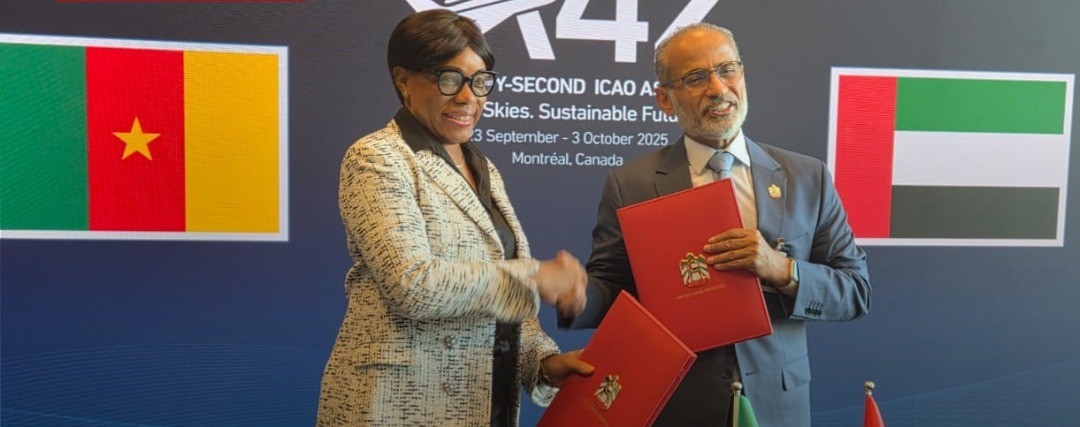
Exchange of folders between Paule Assoumou Koki, Director General CCAA, and Saif Mohammed Al Suwaidi, Director General GCAA.
(LVDE) – A partnership agreement was signed between Paule Assoumou Koki, Director General of the Cameroon Civil Aviation Authority (CCAA), and Saif Mohammed Al Suwaidi, Director General of the General Civil Aviation Authority (GCAA), on September 30, 2025, in Montreal, during the 42nd Assembly of the International Civil Aviation Organization (ICAO). This initiative aims to transform the landscape of civil aviation in Africa while promoting a circular economy.
Cameroon’s aeronautical sector reached a decisive milestone with the signing of a landmark agreement between Cameroon and the United Arab Emirates on September 30, 2025, at ICAO’s 42nd Assembly in Montreal. The agreement, endorsed by Paule Assoumou Koki, Director General of the CCAA, and Saif Mohammed Al Suwaidi, Director General of the GCAA, seeks to democratize access to aeronautical equipment, both new and refurbished.
The initiative revolves around Equip4Safety, an innovative digital platform developed by the CCAA. This collaborative interface aims to revolutionize the exchange and reuse of essential equipment for airport operations and air navigation safety. In a context where flight safety is paramount, Equip4Safety will enable airlines, airports, and suppliers to post, purchase, sell, or exchange equipment while ensuring traceability and compliance with international standards.
The agreement goes beyond simple equipment transactions. It forms part of ICAO’s “No Country Left Behind” initiative, which promotes inclusion and the strengthening of civil aviation authorities’ capacities. The program seeks to reduce equipment disparities between major hubs and resource-limited airports. As the CCAA emphasizes, “Every country, regardless of its wealth, must be able to contribute to a safer global airspace.” This international advocacy marks a turning point for Cameroon, which aspires to play a leading role in regional air safety.
The partnership with the United Arab Emirates is also an opportunity for Cameroon to enhance the standardization of its aeronautical practices. By attracting certified suppliers and pooling acquisition and maintenance costs, the CCAA hopes to shorten lead times for critical spare parts. For the UAE, this cooperation represents an opportunity to showcase its expertise in aviation regulation and safety while contributing to the structuring of an ecosystem aligned with international best practices.
Ultimately, the objective is clear: to raise the level of operational safety in African airspace while democratizing access to quality equipment. By improving access to aeronautical resources, this initiative could reshape the civil aviation landscape across the continent, offering new opportunities for economic operators and strengthening public confidence.
This innovative collaboration between Cameroon and the UAE aligns with a sustainable development and circular economy approach that could redefine aviation standards in Africa. With technical, financial, and strategic support from the UAE, the CCAA is well positioned to meet future challenges and promote a safer and more inclusive aviation environment for all.
Raphael Mforlem
À propos de l'auteur








 Raphael Mforlem